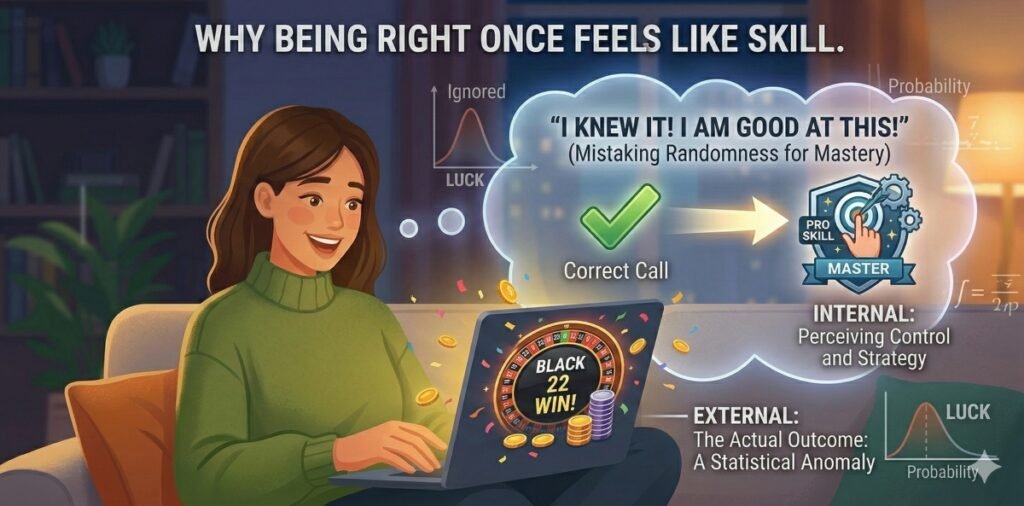


Confidence often arrives early. Understanding takes time. In systems built around repeated decisions, constant feedback, and persistent uncertainty, this gap becomes especially visible. People grow increasingly certain about what they are doing long before they can explain why outcomes occur—or what those outcomes actually represent.
This separation is not accidental. It is a natural result of how confidence and understanding form. They rely on different signals, develop on different timelines, and respond to different kinds of feedback. This psychological drift is heavily influenced by frequency bias and the illusion of proficiency, where repeated exposure is misinterpreted as increasing mastery.
Why Confidence Responds to Exposure
Confidence grows through exposure. The more frequently someone interacts with a system, the less unfamiliar it feels. Familiarity reduces anxiety, and reduced anxiety is often interpreted as competence. Each interaction reinforces the sense that the environment is manageable. Even when outcomes remain unpredictable, navigating the system feels smoother. That smoothness is easily mistaken for skill.
Confidence does not require accuracy. It only requires comfort.
Why Understanding Requires Structure
Understanding does not develop through repetition alone. It requires structure. Understanding emerges from connecting outcomes to underlying rules, constraints, and probabilities.
This process is slow because it depends on abstraction. Patterns cannot be inferred from single events; they must be evaluated across many outcomes. Models must be tested and refined while tolerating ambiguity. Understanding resists fast feedback. It grows in quiet, not intensity.
Why Feedback Strengthens Confidence More Than Insight
In repeated decision environments, feedback is frequent and emotionally charged. Each outcome feels like a response to action. This kind of feedback reinforces confidence because it rewards participation itself. Something happened, therefore something was done. Understanding, however, is not directly reinforced. Systems reward engagement, not correct interpretation.
As a result, insight lags while confidence accelerates—a dynamic that becomes clearer when examining why experience does not eliminate risk bias.
Why Emotional Learning Outpaces Cognitive Learning
Humans learn emotionally faster than they learn analytically. Emotion attaches to outcomes immediately, before meaning is processed. Confidence benefits from this speed. A small number of positive experiences can generate strong belief. Understanding requires slower cognitive work that integrates context, probability, and limitation.
The emotional system reaches conclusions before the analytical system finishes processing. Psychology often describes this pattern as the illusion of validity.
Why Early Certainty Feels Productive
Certainty feels efficient. Doubt feels like delay. When confidence grows quickly, momentum follows. Decisions become easier, hesitation fades, and this efficiency feels like improvement—even when understanding has not deepened. People often mistake decisiveness for insight.
Why Understanding Is Quiet
Understanding rarely announces itself. It does not arrive with emotional highs or clear completion signals. Because it is quiet, it is easy to overlook. Confidence is noticeable because it changes how one feels. Understanding changes how one thinks, which is less immediately visible. Systems that reward action amplify this imbalance.
Why Experience Alone Does Not Close the Gap
Experience provides exposure, not explanation. Without deliberate reflection, the same patterns repeat and reinforce themselves. Confidence grows with every repetition. Understanding requires interruption—pausing, aggregating outcomes, and reevaluating assumptions. When those conditions are absent, the gap widens.
Why the Pattern Persists
Once confidence pulls ahead of understanding, it tends to stay there. Confidence reduces curiosity, and reduced curiosity slows learning. This creates a self-reinforcing loop. People stop asking questions because they feel capable. Confidence continues to rise while understanding plateaus.
Why Recognizing the Gap Matters
The gap between confidence and understanding explains many misjudgments in repeated decision environments. People are not overconfident because they are careless. They are overconfident because systems reward familiarity faster than comprehension.
Confidence grows quickly because it feeds on exposure, emotion, and repetition. Understanding depends on structure, patience, and restraint. Without intentional slowing and reflection, experience alone will continue to widen the distance between them.
Core Takeaway
Confidence and understanding are not synchronized. Confidence thrives on exposure and emotion; understanding requires structure and reflection. Recognizing this gap helps explain why people often feel certain long before they truly comprehend a system. Closing the gap means slowing down, questioning assumptions, and valuing process over immediate reassurance.