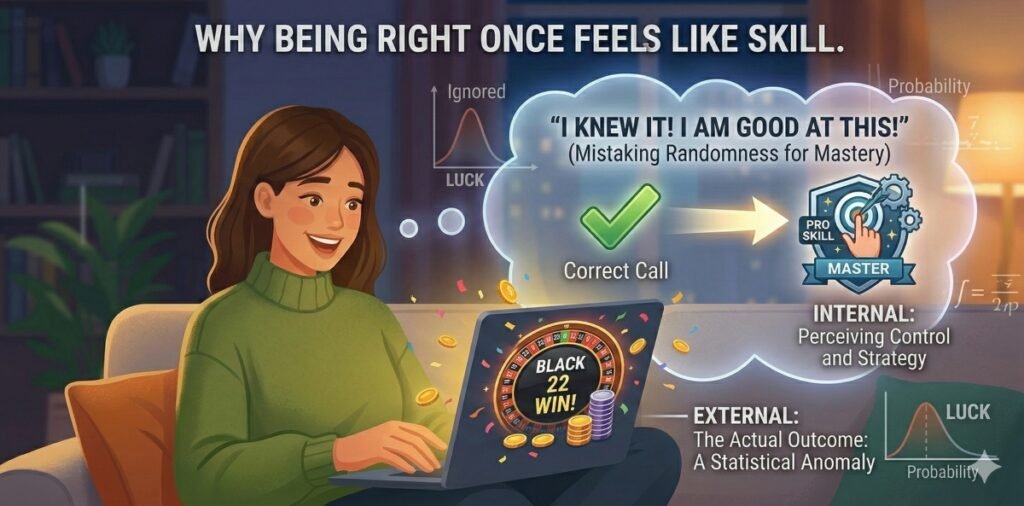


Experience is often treated as a cure for poor judgment. The assumption is that with time and repeated exposure, people learn restraint, accuracy, and realism. In systems involving repeated risk, however, this assumption frequently fails. Confidence grows while accuracy does not. Familiarity increases, yet bias persists.
This is not because experience lacks value. It is because experience interacts with human psychology in a way that tends to reinforce intuition rather than refine understanding. Risk bias survives repetition because repetition does not change how probability behaves—it changes how decisions feel. As a result, bias can remain intact even as experience accumulates.
Why Familiarity Feels Like Skill
Repeated exposure reduces anxiety. What once felt uncertain becomes routine. This reduction in emotional friction is often mistaken for improved judgment.
Familiarity creates comfort, and comfort feels like competence. People assume they understand a system better simply because it no longer feels confusing. In reality, the structure has not become clearer—it has only become familiar.
This miscalibration allows bias to persist beneath a surface that looks like expertise.
Why Experience Reinforces Existing Narratives
People do not enter systems without prior beliefs. Early interpretations shape how later outcomes are processed.
Experience supplies more material to support existing narratives. Wins are remembered. Losses are explained away. Near failures are reframed as progress. Over time, selective memory hardens belief.
Rather than correcting bias, experience often deepens it.
Why Feedback Remains Ambiguous
Experience improves judgment only when feedback is clear and diagnostic. Risk-based systems rarely provide such clarity.
Outcomes do not reliably reflect decision quality. Losses occur even after sound choices, and wins occur after poor ones. Without consistent signals, experience loses its corrective power.
Ambiguous feedback allows bias to persist without being challenged.
Why Emotional Learning Outpaces Statistical Learning
Humans learn emotionally faster than they learn statistically. Every outcome is felt before it is analyzed.
Experience strengthens emotional associations. Certain patterns begin to feel right or wrong regardless of their actual relevance. These feelings guide behavior more powerfully than abstract probability.
As emotional learning accelerates, statistical understanding falls behind—a dynamic closely related to how confidence grows faster than understanding in repeated decision environments, as explored in why confidence outpaces comprehension.
Why Confidence Grows Faster Than Accuracy
Confidence is reinforced by action and familiarity. Accuracy requires aggregation, reflection, and restraint.
Experience provides action but does not automatically provide reflection. As a result, confidence inflates while accuracy stagnates.
This gap explains why more experienced individuals can sometimes be more biased than novices.
Why Experience Does Not Correct the Illusion of Control
Repeated decisions increase the sense of agency. Frequent involvement feels like influence.
Even when outcomes are largely independent, experience creates the illusion that personal adjustment matters. People believe they are adapting effectively even when the risk structure remains unchanged—an effect widely studied as the illusion of control.
Because this illusion strengthens with repetition, it rarely disappears through experience alone.
How Social Reinforcement Locks Bias in Place
Experienced participants often assume social roles as veterans or advisors. Their interpretations gain authority.
Social reinforcement stabilizes bias. When experience is equated with correctness, challenging existing beliefs becomes more difficult.
Bias persists not because it is unexamined, but because it is socially validated.
Why This Pattern Appears Everywhere
These dynamics appear in finance, forecasting, performance evaluation, and any environment involving repeated uncertainty. Experience reduces surprise, not error.
Risk bias is not eliminated by exposure alone. It requires structured reflection, delayed feedback, and explicit recalibration. Without these mechanisms, experience becomes a confidence amplifier, not a corrective tool.
Core Takeaway
Experience does not eliminate risk bias because bias does not arise from inexperience. It arises from how humans interpret feedback under uncertainty. Repetition strengthens intuition faster than accuracy, allowing bias to hide behind the appearance of expertise. True correction requires deliberate reflection, not exposure alone.