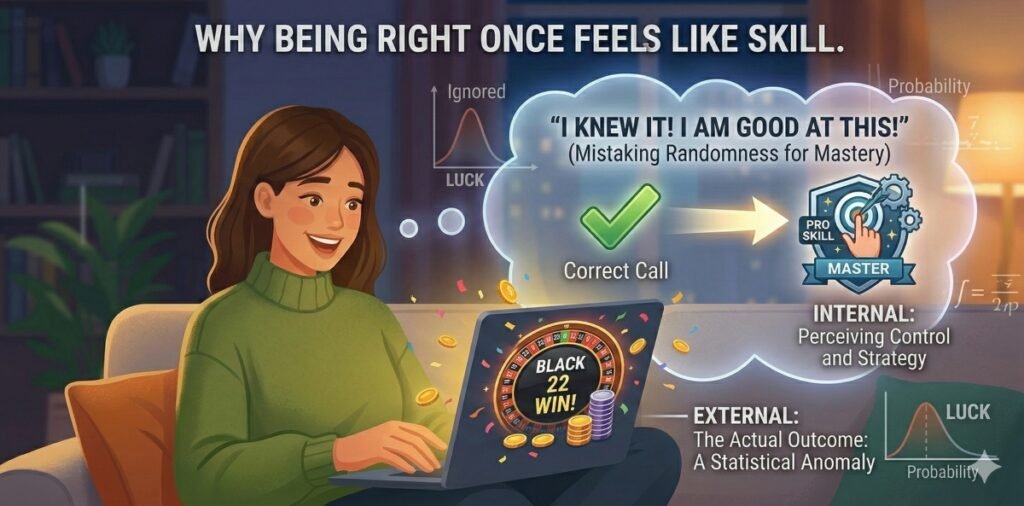


Winning feels definitive. It has closure, relief, and a clean narrative of success. When an outcome goes our way, it is natural to assume we did something right. Over time, wins become a convenient stand-in for ability, improvement, and skill. Losses, by contrast, feel like evidence of failure.
The problem is that in many real-world systems, winning is not a reliable signal. A win is an outcome, not a diagnosis. When it is treated as a performance metric, it obscures more than it reveals. This is especially true in environments where winning loses its meaning as a marker of genuine progress, often masking a decline in underlying skill or strategy.
This article explains why wins repeatedly mislead judgment—especially in environments defined by repetition, uncertainty, and delayed outcomes. It addresses why people can be deteriorating while still winning, improving while still losing, and drifting away from meaningful progress while feeling increasingly confident.
Why Outcomes Are Easier to Judge Than Performance
Humans prefer clear signals. Wins and losses provide emotionally complete, binary feedback. Performance, by contrast, is abstract. It requires interpretation, context, and patience. In noisy systems, performance cannot be directly observed—it must be inferred.
As a result, outcomes become proxies. Wins are treated as evidence of good decisions, losses as evidence of bad ones. This shortcut only works in environments where outcomes accurately reflect underlying quality. Many systems do not behave that way.
In repeated settings with uncertainty, randomness, and delayed feedback, outcomes fluctuate even when performance is stable. The ease of judging wins hides the difficulty of identifying true causes—a dynamic where confidence often grows faster than understanding.
Why Winning and Performance Diverge Over Time
The longer a system operates, the more opportunities arise for outcomes to drift away from underlying quality. Short-term wins can result from favorable conditions rather than sound judgment. Conversely, short-term losses can occur even as decision quality improves.
This creates a dangerous illusion. Early success boosts confidence, reinforces habits, and discourages review. Early failure produces the opposite effect—even when that failure is driven by noise rather than error. Over time, these reactions compound.
Once winning becomes the primary signal, people optimize for immediate positive outcomes instead of long-term performance improvement. This is how behavior that feels successful can quietly worsen future results.
Why Correct Decisions Do Not Guarantee Immediate Progress
Another common assumption is that if decisions are logical, informed, and principled, rewards should follow quickly. When they do not, frustration grows.
The reality is that correctness and reward operate on different time scales. In many systems, sound thinking does not guarantee short-term success—it improves expected value over repeated trials. The more people expect immediate validation, the more likely they are to interpret delay as failure.
This mismatch causes people to abandon good processes too early while doubling down on poor approaches that happen to work briefly. The emotional pull of winning overwhelms the slow feedback provided by genuine performance improvement.
Why Frequent Wins Feel Like Skill
Frequency is persuasive. High win rates feel like evidence of competence because repetition creates familiarity and confidence. However, frequency often reflects feedback structure more than decision quality.
Systems that generate frequent small wins can feel reassuring even in the absence of real improvement. Constant reinforcement masks stagnation. By contrast, systems that reward performance intermittently—even when long-term outcomes are favorable—can feel unstable and discouraging.
Why Early Wins Are Especially Misleading
Initial outcomes carry disproportionate influence. They shape narratives, habits, and self-perception before enough information exists to justify those conclusions.
Early wins feel like confirmation that an approach is correct, reducing curiosity and reinforcing commitment. Early losses can brand even structurally sound strategies as flawed. Ironically, early results are statistically the noisiest, yet psychologically they are treated as the most meaningful.
Why Win Rate Is Confused With Value
Win rate is simple. It counts how often positive outcomes occur. Value is complex. It depends on magnitude, context, and long-term consequences.
When these are confused, people prioritize feeling successful over being effective. A high win rate with small gains may produce worse performance than a lower win rate that generates meaningful progress—yet the former feels safer and more competent.
Why Systems Reinforce This Confusion
Many systems unintentionally reward outcome-based evaluation because it is cheap, fast, and easy to understand. Counting wins is far simpler than assessing performance quality. It simplifies reporting, ranking, and comparison. Over time, participants internalize the system’s evaluation criteria. Visible success is pursued over genuine improvement.
Why Winning Still Matters—But Less Than People Think
Winning is not meaningless. Outcomes contain information—but far less than people assume. The problem is not paying attention to wins. The problem is treating them as decisive evidence of performance. Once wins are elevated to the primary signal, learning slows and misinterpretation accelerates.
This error aligns with outcome bias, the tendency to judge decisions by results rather than by the quality of the process. Winning feels good. But where you end up is determined by performance. Confusing the two is one of the most reliable ways to feel successful while quietly falling behind.
Core Takeaway
Winning is seductive but misleading. It provides closure and confidence, yet it hides the slow, structural signals of genuine performance. True progress is measured by process quality, long-term value, and resilience under uncertainty—not by short-term outcomes. Recognizing this distinction helps prevent the trap of mistaking success for skill, and ensures that improvement remains the real goal.