Sejong Insider

The “Sunk Cost” Trap: Why It Is Hard to Stop After a Loss and How to Stay in Control

Imagine you are waiting for a bus. You have already waited for 30 minutes, but it has not arrived. You are worried you will be late. You could call a taxi right now and still arrive on time. However, you think to yourself, “I have already waited 30 minutes. If I leave now, that time was wasted. I should wait just a little longer.”

Another 20 minutes pass. The bus still hasn’t come. Now you are definitely late, and you are too frustrated to call a taxi.

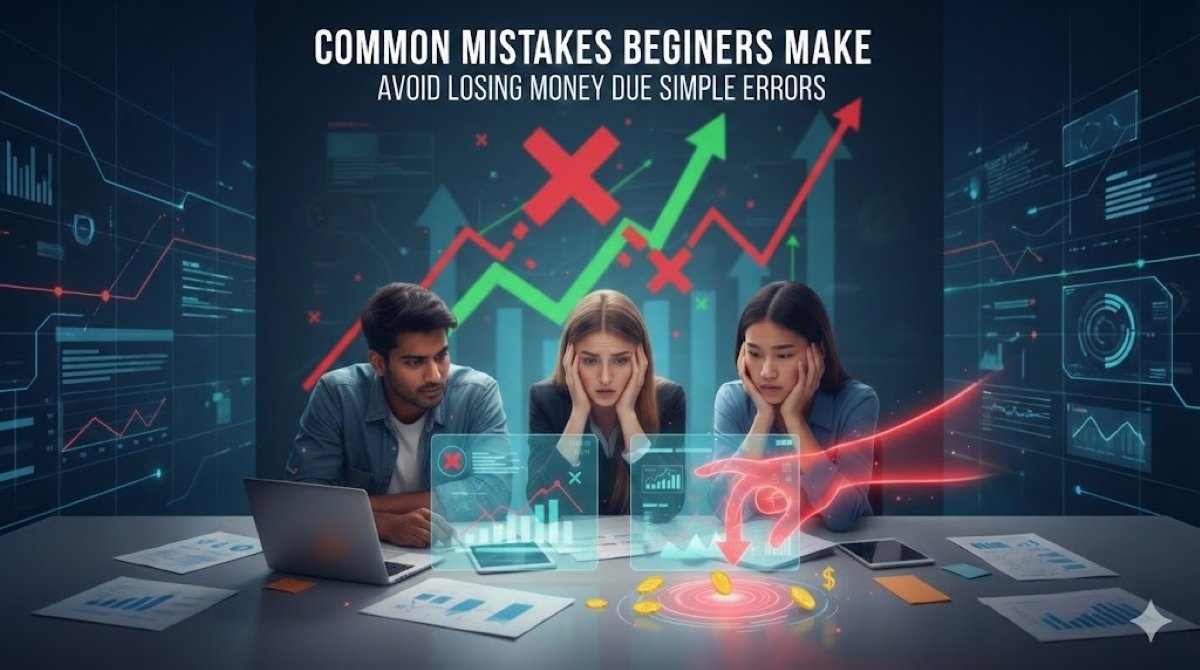
This situation is a perfect example of a psychological trap that affects almost everyone. In finance and decision-making, this is called the “Sunk Cost” fallacy or trap. It is one of the main reasons beginners lose control of their money and make losses much bigger than they need to be.

This article will explain what this trap is in simple terms, why our brains fall for it, and how you can learn to escape it.

What is a “Sunk Cost”?

To understand the trap, we must first understand what a “sunk cost” is.

A sunk cost is any money, time, or effort you have already spent that you cannot get back. It is gone forever.

  • The price of a movie ticket you already bought is a sunk cost.

  • The three years you spent studying a subject you no longer like is a sunk cost.

  • The money you lost on an investment yesterday is a sunk cost.

The core rule of smart decision-making is this: Sunk costs should not affect your future decisions. Because that money or time is already gone, it does not matter anymore. You should only focus on what is best for your future right now.

The Trap: Throwing Good Money After Bad

The “trap” happens when we ignore that rule. Instead of looking forward, we look backward at what we already spent. We feel an emotional need to “justify” the past expense or try to “win back” the loss.

In financial terms, this often leads to the dangerous habit of “throwing good money after bad.”

For example, imagine you bought some shares in a company for $1,000. A week later, the company has bad news, and your shares are now only worth $700. You have a “paper loss” of $300.

A logical approach would be to ask: “Is this company likely to recover soon?” If the answer is no, the best move is to sell, accept the $300 loss, and save the remaining $700.

However, the Sunk Cost Trap makes you think differently. You might think, “I cannot sell now; I will lock in the loss! I need to wait until it gets back to $1,000 so I can break even.” Some people even buy more shares, trying to lower their average price.

Often, the price keeps dropping, and the $300 loss turns into a $600 loss. You tried to save the initial sunk cost, and it cost you even more money.

Why Is It So Hard to Stop?

Why do intelligent humans do this? It is not because we are stupid; it is because we are emotional.

1. Loss Aversion

Psychologists have found that humans feel the pain of a loss twice as strongly as the joy of a gain. Losing $100 feels much worse than finding $100 feels good. We will do almost anything to avoid admitting we have officially lost money.

2. Fear of Waste

We are taught from a young age not to be wasteful. Admitting a mistake feels like admitting you wasted time or money. We stick with bad projects because we want to believe our initial effort had value.

3. Hope over Logic

When we are in a losing position, we stop thinking with facts and start thinking with hope. We hope the situation will turn around magically, even if all the evidence says it will get worse.

How to Stay in Control and Escape the Trap

Recognizing that this trap exists is the first step to beating it. Here are practical ways to stay in control when you are facing a loss.

The “Clean Slate” Test

If you are holding a losing investment and don’t know if you should sell, use this mental trick. Imagine you do not own the investment at all. You have cash in your hand instead.

Now, look at that investment today. Would you buy it right now at its current price?

If the answer is “No, I wouldn’t buy that today,” then you should sell it immediately. If it’s not good enough to buy today, it is not good enough to keep.

Focus on the Future Opportunity

Do not think about the money you lost. Think about what the remaining money could do.

If you have a $700 remaining value from a bad investment, don’t focus on the missing $300. Focus on the fact that the $700 is currently “trapped” in a bad spot. If you sell, you free up that $700 to be placed into a much better opportunity that might actually grow.

Set Rules Before You Start

The best way to avoid emotional decisions is to make rules when you are calm. Before you put money into anything, decide your “exit point.”

Decide, “If this drops by 10%, I will sell immediately, no questions asked.” This is often called a “stop-loss.” When you hit that point, do not argue with yourself. Just follow the rule you made earlier.

It is painful to accept that money is gone. No one likes to lose. However, successful people understand that trying to fix a past mistake by spending more money is a recipe for disaster.

The Sunk Cost Trap is just a trick of the mind. By letting go of the past and focusing only on the best action for today, you can regain control of your decisions and protect your future finances. Sometimes, the smartest thing you can do is quit.
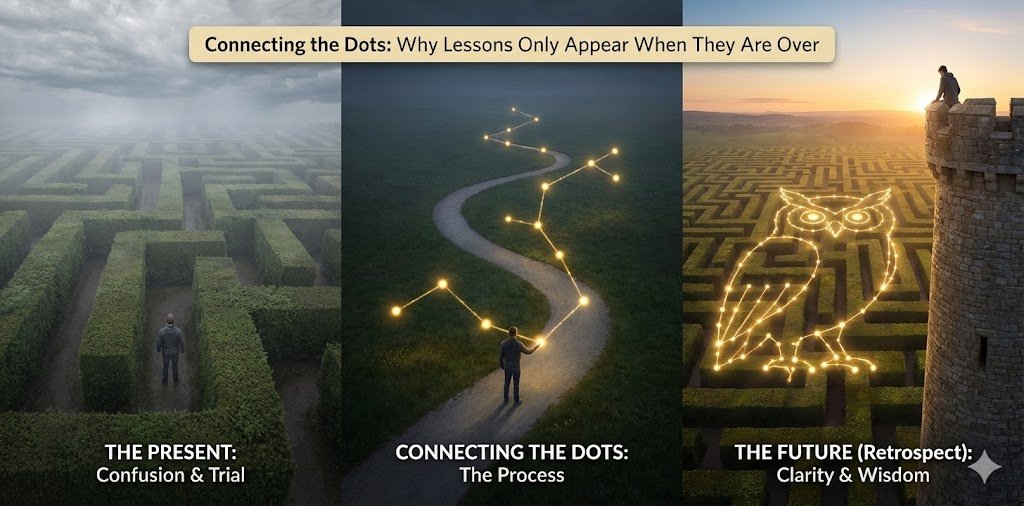

Why Lessons Only Appear When They Are Over

Have you ever gone through a very hard time in your life? Maybe you lost a job, a relationship ended, or you failed at a big project. At that moment, you probably felt confused, angry, or sad. You might have asked yourself, “Why is this happening to me?” Everything felt like a messy puzzle with missing pieces.

But then, a year or two later, you look back at that same difficult time. Suddenly, everything looks different. You think, “Ah, I see now. I had to lose that job to find this better one,” or “That failure taught me what I really needed to know.”

This feeling is very common. It seems that life’s biggest lessons only become clear after the difficult part is over. A famous man named Steve Jobs once said, “You can’t connect the dots looking forward; you can only connect them looking backward.”

Why does our brain work this way? Why can’t we see the lesson while we are learning it? Let’s explore the simple psychology behind why clarity only comes in retrospect.

Living inside the Maze

Imagine life is a giant hedge maze. When you are standing inside the maze, all you can see are tall green walls. You don’t know if you should turn left or right. You might choose a path that leads to a dead end, and you have to turn around. You feel frustrated and lost.

This is what it feels like to live in the “present moment.” When you are in the middle of a problem, you are inside the maze. You do not have all the information. You are making guesses based on what is right in front of you.

Your brain is also busy dealing with strong emotions. Fear, worry, and stress act like a fog. They make it hard to think clearly. When your brain is in “survival mode,” it is focused on getting through the day, not on learning a big life lesson. You are too close to the problem to see the solution.

The Science of “Hindsight”

Now, imagine that enough time has passed, and you have finally found your way out of the maze. You climb up a tall tower and look down. From up high, the maze looks very simple. You can clearly see the start, the finish, and the exact path you took. You can also see all the wrong turns you made and why they were wrong.

This view from the tower is called “retrospect.” In psychology, there is something called hindsight bias. This is a fancy term for the feeling that “I knew it all along.”

Once your brain knows the ending of a story, it tricks you. It goes back into your memory and deletes the confusion you felt at the time. It highlights only the clues that point to the final outcome. It makes the past look like a straight, obvious line, even though it felt like a messy scribble when you were living it.

Think of a child’s “connect-the-dots” drawing. When there are just numbered dots on a page, you don’t know what the picture is. You have to draw the lines, one by one, from 1 to 2 to 3. Only when you connect the final dot does the full picture appear. You cannot see the picture before you draw the lines. Life is the same. You have to live through the events—connect the dots—before you can see the lesson.

A Story About a Bridge

Let’s look at a simple story. A man named Leo wanted to build a small wooden bridge over a stream in his backyard. He had never built a bridge before.

While he was building it, Leo was very stressed. He worried that the wood wasn’t strong enough. He wasn’t sure if the supporting stones were in the right spots. He made mistakes; sometimes the wood would crack, or a stone would slip. He felt like a bad builder and wanted to quit many times. He was “inside the maze.”

A year later, the bridge was finished and standing strong. Leo stood on top of it and looked down. In retrospect, everything was clear. He could see that the wood cracked because he didn’t drill a pilot hole first. He saw that the stone slipped because the ground was too wet that day.

The lessons were obvious now because the work was done. In the moment, he was fighting the problems. In retrospect, he was studying the results. The confusion he felt back then was just the necessary process of learning how to build.

How to Trust the Process

So, what can we do with this information? It is important to be kind to yourself when things are tough.

Don’t beat yourself up for not knowing the future. It is impossible to know the lesson before you have finished the experience. Trust that the confusion you feel right now is normal. It does not mean you are failing; it just means you are still connecting the dots.

Be patient in the messy middle. Keep moving forward, even if you don’t know exactly where you are going. One day, you will look back from your own tower, and it will all make perfect sense. The clarity is coming; it is just waiting for you at the end of the path.

Why Experience Does Not Eliminate Risk Bias

Experience is often treated as a cure for poor judgment. The assumption is that with time and repeated exposure, people learn restraint, accuracy, and realism. In systems involving repeated risk, however, this assumption frequently fails. Confidence grows while accuracy does not. Familiarity increases, yet bias persists.

This is not because experience lacks value. It is because experience interacts with human psychology in a way that tends to reinforce intuition rather than refine understanding. Risk bias survives repetition because repetition does not change how probability behaves—it changes how decisions feel. As a result, bias can remain intact even as experience accumulates.

Why Familiarity Feels Like Skill

Repeated exposure reduces anxiety. What once felt uncertain becomes routine. This reduction in emotional friction is often mistaken for improved judgment.

Familiarity creates comfort, and comfort feels like competence. People assume they understand a system better simply because it no longer feels confusing. In reality, the structure has not become clearer—it has only become familiar.

This miscalibration allows bias to persist beneath a surface that looks like expertise.

Why Experience Reinforces Existing Narratives

People do not enter systems without prior beliefs. Early interpretations shape how later outcomes are processed.

Experience supplies more material to support existing narratives. Wins are remembered. Losses are explained away. Near failures are reframed as progress. Over time, selective memory hardens belief.

Rather than correcting bias, experience often deepens it.

Why Feedback Remains Ambiguous

Experience improves judgment only when feedback is clear and diagnostic. Risk-based systems rarely provide such clarity.

Outcomes do not reliably reflect decision quality. Losses occur even after sound choices, and wins occur after poor ones. Without consistent signals, experience loses its corrective power.

Ambiguous feedback allows bias to persist without being challenged.

Why Emotional Learning Outpaces Statistical Learning

Humans learn emotionally faster than they learn statistically. Every outcome is felt before it is analyzed.

Experience strengthens emotional associations. Certain patterns begin to feel right or wrong regardless of their actual relevance. These feelings guide behavior more powerfully than abstract probability.

As emotional learning accelerates, statistical understanding falls behind—a dynamic closely related to how confidence grows faster than understanding in repeated decision environments, as explored in this analysis of why confidence outpaces comprehension.

Why Confidence Grows Faster Than Accuracy

Confidence is reinforced by action and familiarity. Accuracy requires aggregation, reflection, and restraint.

Experience provides action but does not automatically provide reflection. As a result, confidence inflates while accuracy stagnates.

This gap explains why more experienced individuals can sometimes be more biased than novices.

Why Experience Does Not Correct the Illusion of Control

Repeated decisions increase the sense of agency. Frequent involvement feels like influence.

Even when outcomes are largely independent, experience creates the illusion that personal adjustment matters. People believe they are adapting effectively even when the risk structure remains unchanged—an effect widely studied as the illusion of control.

Because this illusion strengthens with repetition, it rarely disappears through experience alone.

How Social Reinforcement Locks Bias in Place

Experienced participants often assume social roles as veterans or advisors. Their interpretations gain authority.

Social reinforcement stabilizes bias. When experience is equated with correctness, challenging existing beliefs becomes more difficult.

Bias persists not because it is unexamined, but because it is socially validated.

Why This Pattern Appears Everywhere

These dynamics appear in finance, forecasting, performance evaluation, and any environment involving repeated uncertainty. Experience reduces surprise, not error.

Risk bias is not eliminated by exposure alone. It requires structured reflection, delayed feedback, and explicit recalibration. Without these mechanisms, experience becomes a confidence amplifier, not a corrective tool.

Experience does not eliminate risk bias because bias does not arise from inexperience. It arises from how humans interpret feedback under uncertainty. Repetition strengthens intuition faster than accuracy, allowing bias to hide behind the appearance of expertise.

Why Humans Expect Balance in Random Sequences

When people encounter random outcomes, they instinctively expect balance. Wins should offset losses. High results should be followed by low ones. Over time, things are expected to flatten out in a visible, orderly way. When this does not happen, randomness begins to feel suspicious.

This expectation runs deep. It feels intuitive, reasonable, and fair. Yet it does not reflect how random processes actually behave. Randomness does not aim for balance in short sequences. It naturally produces clustering, streaks of wins or losses, and uneven distributions as a consequence of chance itself. This persistent psychological tension is the reason humans frequently misinterpret random sequences, as the brain struggles to accept that true randomness looks far messier than our mental models of it.


Why Balance Feels Like Fairness

Humans tend to associate balance with justice. In everyday life, effort is often rewarded and mistakes are often corrected. Over time, things usually even out in ways that feel reasonable.

These experiences shape how randomness is interpreted. A balanced sequence aligns with moral intuition and therefore feels fair. An imbalanced sequence violates expectations about how things should unfold and therefore feels unfair. Random systems are indifferent to fairness. They do not self-correct to satisfy human intuition.


Why the Mind Searches for Symmetry

The human brain is a pattern-detection machine. It evolved to look for order, symmetry, and repetition—traits that were useful in predictable environments. In random sequences, this instinct misfires. The mind expects alternation and correction even when no causal relationship exists. When results repeat or cluster, the brain assumes something has changed.

Symmetry feels normal. Asymmetry feels suspicious.


Why Short Sequences Dominate Perception

People rarely evaluate randomness using large samples. Instead, randomness is experienced in short runs. In short sequences, imbalance is common. Long streaks, clusters, and gaps occur naturally. Without sufficient context, these sequences feel meaningful rather than expected.

Because early experiences dominate memory, people conclude that randomness itself is malfunctioning—a pattern that closely mirrors why early outcomes disproportionately shape judgment, as discussed in this analysis of why early wins are especially misleading.


How Recency Bias Strengthens the Expectation

Recent outcomes feel more informative than earlier ones. When a sequence leans heavily in one direction, recency bias amplifies discomfort. Instead of recognizing that randomness allows uneven runs, people believe balance is overdue. The longer the imbalance persists, the stronger the expectation becomes. This creates the false belief that the next outcome must restore balance.


Why Clustering Feels Like Manipulation

Clustering violates intuition. When the same result appears repeatedly, it feels intentional. People assume systems should prevent extreme streaks. When they do not, suspicion grows. Randomness is reinterpreted as bias, manipulation, or design failure.

In reality, clustering is not a failure of randomness—it is one of its defining features. This misunderstanding is commonly known as the gambler’s fallacy.


Why the Law of Large Numbers Is Misapplied

Many people vaguely understand that outcomes tend to converge toward averages over time. This idea, however, is often misused. Balance emerges statistically across very large samples—not emotionally salient short sequences. Expecting rapid balance applies a long-term principle to short-term experience. This misapplication fuels disappointment and mistrust.


Why Experience Rarely Corrects the Expectation

Even repeated exposure rarely eliminates the expectation of balance. Emotional responses to imbalance are strong and persistent. People remember extreme streaks more vividly than ordinary runs. These memories reinforce the belief that imbalance is abnormal. Intellectual understanding of randomness does not automatically regulate how imbalance feels.


Why This Expectation Appears Everywhere

The expectation of balance appears in games, finance, forecasting, and everyday judgment. Wherever randomness is encountered repeatedly, the same discomfort emerges. Humans did not evolve to intuitively understand probability distributions. They evolved to respond to patterns. Randomness exploits that mismatch.

Humans expect balance in random sequences because balance feels fair, orderly, and reassuring. Randomness does not share those priorities. It naturally produces imbalance—often early, frequently, and without explanation. Until this difference is recognized, random sequences will continue to feel wrong even when they are functioning exactly as intended.

Why Confidence Grows Faster Than Understanding

Confidence often arrives early. Understanding takes time. In systems built around repeated decisions, constant feedback, and persistent uncertainty, this gap becomes especially visible. People grow increasingly certain about what they are doing long before they can explain why outcomes occur—or what those outcomes actually represent.

This separation is not accidental. It is a natural result of how confidence and understanding form. They rely on different signals, develop on different timelines, and respond to different kinds of feedback. This psychological drift is heavily influenced by frequency bias and the illusion of proficiency, where repeated exposure is misinterpreted as increasing mastery.


Why Confidence Responds to Exposure

Confidence grows through exposure. The more frequently someone interacts with a system, the less unfamiliar it feels. Familiarity reduces anxiety, and reduced anxiety is often interpreted as competence. Each interaction reinforces the sense that the environment is manageable. Even when outcomes remain unpredictable, navigating the system feels smoother. That smoothness is easily mistaken for skill.

Confidence does not require accuracy. It only requires comfort.


Why Understanding Requires Structure

Understanding does not develop through repetition alone. It requires structure. Understanding emerges from connecting outcomes to underlying rules, constraints, and probabilities.

This process is slow because it depends on abstraction. Patterns cannot be inferred from single events; they must be evaluated across many outcomes. Models must be tested and refined while tolerating ambiguity. Understanding resists fast feedback. It grows in quiet, not intensity.


Why Feedback Strengthens Confidence More Than Insight

In repeated decision environments, feedback is frequent and emotionally charged. Each outcome feels like a response to action. This kind of feedback reinforces confidence because it rewards participation itself. Something happened, therefore something was done. Understanding, however, is not directly reinforced. Systems reward engagement, not correct interpretation.

As a result, insight lags while confidence accelerates—a dynamic that becomes clearer when examining why experience alone often fails to eliminate bias, as discussed in this analysis of why experience does not eliminate risk bias.


Why Emotional Learning Outpaces Cognitive Learning

Humans learn emotionally faster than they learn analytically. Emotion attaches to outcomes immediately, before meaning is processed. Confidence benefits from this speed. A small number of positive experiences can generate strong belief. Understanding requires slower cognitive work that integrates context, probability, and limitation.

The emotional system reaches conclusions before the analytical system finishes processing. Psychology often describes this pattern as the illusion of validity.


Why Early Certainty Feels Productive

Certainty feels efficient. Doubt feels like delay. When confidence grows quickly, momentum follows. Decisions become easier, hesitation fades, and this efficiency feels like improvement—even when understanding has not deepened. People often mistake decisiveness for insight.


Why Understanding Is Quiet

Understanding rarely announces itself. It does not arrive with emotional highs or clear completion signals. Because it is quiet, it is easy to overlook. Confidence is noticeable because it changes how one feels. Understanding changes how one thinks, which is less immediately visible. Systems that reward action amplify this imbalance.


Why Experience Alone Does Not Close the Gap

Experience provides exposure, not explanation. Without deliberate reflection, the same patterns repeat and reinforce themselves. Confidence grows with every repetition. Understanding requires interruption—pausing, aggregating outcomes, and reevaluating assumptions. When those conditions are absent, the gap widens.


Why the Pattern Persists

Once confidence pulls ahead of understanding, it tends to stay there. Confidence reduces curiosity, and reduced curiosity slows learning. This creates a self-reinforcing loop. People stop asking questions because they feel capable. Confidence continues to rise while understanding plateaus.


Why Recognizing the Gap Matters

The gap between confidence and understanding explains many misjudgments in repeated decision environments. People are not overconfident because they are careless. They are overconfident because systems reward familiarity faster than comprehension.

Confidence grows quickly because it feeds on exposure, emotion, and repetition. Understanding depends on structure, patience, and restraint. Without intentional slowing and reflection, experience alone will continue to widen the distance between them.

When Efficient Systems Feel Unfair

Efficient systems are designed to operate quickly and consistently. Information moves fast, responses converge, and outcomes reflect signals with minimal delay. From a technical standpoint, this is often how fairness is implemented at scale: the same rules are applied uniformly, with speed and reach. Yet the lived experience of people inside these systems frequently tells a different story. Outcomes appear uneven, advantages seem to cluster, and losses recur in ways that feel difficult to explain.

This is where tension emerges. Efficiency optimizes how a system processes information. Fairness, by contrast, is judged through the experience of those affected by the results. When these two standards begin to diverge, even a well-designed system can feel unfair. This is a primary reason why fair systems can feel as though they are manipulated or rigged, as individuals struggle to reconcile technical neutrality with their personal results.

Understanding this gap requires separating how systems are designed from how humans experience them. Market efficiency and fairness are not opposites. They optimize for different objectives. When they align, trust forms. When they separate, systems can feel manipulated even in the absence of manipulation.


What Market Efficiency Actually Means

Market efficiency is a descriptive concept, not a moral one. At its simplest, an efficient market is one where available information is rapidly reflected in outcomes. Prices adjust, signals are absorbed, and advantages based on public information disappear quickly as many participants respond at once. In economics, this idea is often described through versions of the efficient market hypothesis.

Efficiency does not guarantee equal outcomes. It does not reward effort evenly, nor does it account for intention. Its function is alignment, not justice. As markets become more efficient, predictable advantages shrink, and competition over timing, access, and interpretation intensifies. This compression makes outcomes feel harsher, because there is less room for error.


What People Mean by Fairness

Fairness is not a single metric. It is a judgment shaped by process, context, and expectation. People assess fairness based on whether rules were applied consistently, whether effort seemed respected, and whether outcomes felt proportional to inputs. Visibility also matters. The more people understand why something happened, the easier it is to accept an unfavorable result.

Unlike efficiency, fairness is evaluated locally. People do not experience markets as abstract systems. They experience them through sequences of outcomes, near misses, delays, and feedback. A system can be statistically fair in aggregate while feeling unfair to participants whose repeated experiences conflict with what the rules seem to promise.


Why Efficient Systems Often Feel Unfair

Efficient systems amplify small differences quickly. Timing, access to information, and initial position compound into meaningful gaps over short periods. When outcomes begin clustering in one direction, observers infer structure. Repeated success looks like privilege. Repeated failure feels like exclusion.

Opacity compounds this effect. To maintain speed and scale, efficient systems often obscure their internal mechanics. Algorithms, pricing models, queues, and ranking systems prioritize performance over interpretability. When results are visible but explanations are not, people fill the gap with narratives—especially when humans instinctively expect balance in random sequences, even when no such balance exists, a tendency explored in this discussion of why people expect fairness in randomness.

The mismatch between effort and reward also plays a role. Humans expect effort to correlate roughly with outcome. Efficient markets routinely violate this intuition. Effort may be necessary, but it is rarely sufficient. Without favorable conditions, significant input can produce no result.


Aggregate Fairness Versus Individual Experience

A system can be statistically fair across all participants while generating sustained disadvantage in specific segments. This creates a gap between aggregate outcomes and personal narratives. People do not judge fairness by averages. They judge it by their own sample.

This local perspective matters because trust forms through repeated experience, not abstract explanation. For someone who consistently encounters losses under consistent rules, assurances of overall fairness do not resolve the emotional contradiction. Their data tells a different story.


Why This Tension Matters

Understanding the difference between efficiency and fairness is not about choosing one over the other. It is about recognizing that systems optimized for performance are not optimized for human perception. When this gap is ignored, confusion and resentment fill the space.

Market efficiency answers the question: Does this system process information well?

Fairness answers the question: Does this experience feel just to me?

When those answers diverge, the resulting conflict is not a failure. It is a predictable outcome of humans interpreting systems that move faster than intuition.

Why Winning Is a Poor Measure of Performance

Winning feels definitive. It has closure, relief, and a clean narrative of success. When an outcome goes our way, it is natural to assume we did something right. Over time, wins become a convenient stand-in for ability, improvement, and skill. Losses, by contrast, feel like evidence of failure.

The problem is that in many real-world systems, winning is not a reliable signal. A win is an outcome, not a diagnosis. When it is treated as a performance metric, it obscures more than it reveals. This is especially true in environments where winning loses its meaning as a marker of genuine progress, often masking a decline in underlying skill or strategy.

This article explains why wins repeatedly mislead judgment—especially in environments defined by repetition, uncertainty, and delayed outcomes. It addresses why people can be deteriorating while still winning, improving while still losing, and drifting away from meaningful progress while feeling increasingly confident.


Why Outcomes Are Easier to Judge Than Performance

Humans prefer clear signals. Wins and losses provide emotionally complete, binary feedback. Performance, by contrast, is abstract. It requires interpretation, context, and patience. In noisy systems, performance cannot be directly observed—it must be inferred.

As a result, outcomes become proxies. Wins are treated as evidence of good decisions, losses as evidence of bad ones. This shortcut only works in environments where outcomes accurately reflect underlying quality. Many systems do not behave that way.

In repeated settings with uncertainty, randomness, and delayed feedback, outcomes fluctuate even when performance is stable. The ease of judging wins hides the difficulty of identifying true causes—a dynamic where confidence often grows faster than understanding.


Why Winning and Performance Diverge Over Time

The longer a system operates, the more opportunities arise for outcomes to drift away from underlying quality. Short-term wins can result from favorable conditions rather than sound judgment. Conversely, short-term losses can occur even as decision quality improves.

This creates a dangerous illusion. Early success boosts confidence, reinforces habits, and discourages review. Early failure produces the opposite effect—even when that failure is driven by noise rather than error. Over time, these reactions compound.

Once winning becomes the primary signal, people optimize for immediate positive outcomes instead of long-term performance improvement. This is how behavior that feels successful can quietly worsen future results.


Why Correct Decisions Do Not Guarantee Immediate Progress

Another common assumption is that if decisions are logical, informed, and principled, rewards should follow quickly. When they do not, frustration grows.

The reality is that correctness and reward operate on different time scales. In many systems, sound thinking does not guarantee short-term success—it improves expected value over repeated trials. The more people expect immediate validation, the more likely they are to interpret delay as failure.

This mismatch causes people to abandon good processes too early while doubling down on poor approaches that happen to work briefly. The emotional pull of winning overwhelms the slow feedback provided by genuine performance improvement.


Why Frequent Wins Feel Like Skill

Frequency is persuasive. High win rates feel like evidence of competence because repetition creates familiarity and confidence. However, frequency often reflects feedback structure more than decision quality.

Systems that generate frequent small wins can feel reassuring even in the absence of real improvement. Constant reinforcement masks stagnation. By contrast, systems that reward performance intermittently—even when long-term outcomes are favorable—can feel unstable and discouraging.


Why Early Wins Are Especially Misleading

Initial outcomes carry disproportionate influence. They shape narratives, habits, and self-perception before enough information exists to justify those conclusions.

Early wins feel like confirmation that an approach is correct, reducing curiosity and reinforcing commitment. Early losses can brand even structurally sound strategies as flawed. Ironically, early results are statistically the noisiest, yet psychologically they are treated as the most meaningful.


Why Win Rate Is Confused With Value

Win rate is simple. It counts how often positive outcomes occur. Value is complex. It depends on magnitude, context, and long-term consequences.

When these are confused, people prioritize feeling successful over being effective. A high win rate with small gains may produce worse performance than a lower win rate that generates meaningful progress—yet the former feels safer and more competent.


Why Systems Reinforce This Confusion

Many systems unintentionally reward outcome-based evaluation because it is cheap, fast, and easy to understand. Counting wins is far simpler than assessing performance quality. It simplifies reporting, ranking, and comparison. Over time, participants internalize the system’s evaluation criteria. Visible success is pursued over genuine improvement.


Why Winning Still Matters—But Less Than People Think

Winning is not meaningless. Outcomes contain information—but far less than people assume. The problem is not paying attention to wins. The problem is treating them as decisive evidence of performance. Once wins are elevated to the primary signal, learning slows and misinterpretation accelerates.

This error aligns with outcome bias, the tendency to judge decisions by results rather than by the quality of the process—a concept well documented in behavioral science research on outcome bias.

Winning feels good. But where you end up is determined by performance. Confusing the two is one of the most reliable ways to feel successful while quietly falling behind.

What Odds Actually Mean (and What They Do Not)

Odds are commonly treated as predictions. The numbers appear to signal what will happen next, how likely an outcome is, or which side is “right.” When the direction implied by the odds does not match the eventual result, confusion follows. Systems feel opaque, numbers lose credibility, and doubts about fairness emerge.

But odds were never designed to predict the future. They are not promises, forecasts, or guarantees of probability. Odds are a system signal, a way to distribute risk, manage exposure, and regulate participation under uncertainty. Much of this friction arises from the structural reasons why odds are so easily misunderstood, particularly when they are viewed as objective truths rather than dynamic market prices. Most confusion around odds arises from the gap between how people interpret them and what they are designed to do. Without understanding this gap, nearly every misunderstanding about odds repeats itself.


Why Odds Feel Like Predictions Even Though They Are Not

Humans tend to treat numbers as statements about reality. The more precise a number appears, the more objective and trustworthy it feels. When odds are expressed as ratios or probabilities, they are easily perceived as measurements of the future. This perceptual shortcut explains why odds feel predictive even when they are not.

In practice, odds function less like statements and more like signals. They compress available information, participation levels, and internal constraints into a single figure. They do not claim that a specific outcome will occur. They indicate where exposure is accumulating under current conditions. The problem begins the moment people assign predictive meaning to the number. Systems are designed to react to inputs, not to foresee events.


The Role Odds Are Designed to Play in a System

The primary purpose of odds is balance management. Systems aim to distribute risk so that no single outcome creates excessive exposure. To do this, odds respond continuously not only to information, but also to participant behavior.

When participation concentrates on one side, odds adjust. When uncertainty widens, ranges expand. When exposure tilts, prices move back. This is why odds can change even when nothing visible appears to have happened. Another critical element is that odds quietly include the system’s revenue structure. The system is not a neutral observer; it must remain viable over time. This cost component is not presented explicitly, but it is embedded throughout the design of the odds.

Odds are not merely numbers about possibility. They are adjustment outcomes that support system stability. Understanding how odds quietly embed system revenue is a necessary step in recognizing that these figures are prices rather than pure probabilities.


Why Different Odds Formats Create Confusion

Odds are expressed in multiple formats not because reality changes, but because interpretive emphasis changes. Decimal odds, fractional odds, and implied probability present the same relationship from different angles.

Each format highlights a different aspect of risk. Decimal odds foreground total return, fractional odds emphasize relative gain, and probability notation centers likelihood. According to communication guidelines from the Risk Management Society (RIMS), the way risk information is framed significantly alters how individuals perceive the severity and likelihood of potential outcomes. The mathematics remain the same, but psychological responses differ sharply. This is not a calculation problem. It is a communication problem. The format shapes perception, which is why odds can feel contradictory across contexts.


Why Odds Reflect Crowds as Much as Facts

It is easy to assume odds move only when new information appears. In reality, participation often matters more. When many people converge on the same choice, the system must respond, regardless of whether that choice is correct.

In this way, odds often reflect collective behavior more strongly than underlying facts. Systems do not evaluate beliefs; they price the exposure those beliefs create. This structure explains why odds can act like compressed signals of crowd behavior.


Misunderstanding Odds Is Natural, Not Ignorance

Most people assume numbers explain reality and that change implies new information. This assumption works well in everyday contexts. It fails repeatedly in systems governed by odds.

Odds combine mathematics, human behavior, and system design into a single figure presented without explanation. Misinterpretation is therefore structural, not personal. Familiarity does not reliably correct intuition; it often reinforces confidence instead.


What Odds Do Not Tell You

Odds do not tell you what will actually happen. They do not define what is fair, what is deserved, or what is true. They do not evaluate effort, reward insight, or promise that balance will emerge over time. They show only how uncertainty is being priced under constraints that are not directly visible.


Why This Distinction Matters

When odds are treated as predictions, unexpected outcomes feel like failure or deception. When odds are understood as system signals, mismatches can be explained without assuming bad intent. This understanding does not remove risk. It reduces confusion. Odds are not promises. They are messages. And like any message, they only make sense when you understand what the sender is trying to do.

Why Probability Figures Feel Like Predictions — but Are Not

Probability figures often feel like predictions. When people see a numerical likelihood attached to an outcome, they instinctively interpret it as a statement about what will happen next. High numbers feel reassuring, while low numbers feel easy to dismiss. This reaction is intuitive, but deeply misleading.

The core issue is that probability figures are not designed to promise the future. They describe relative likelihood within uncertainty, and in many cases, they are generated inside systems designed to manage risk and maintain balance rather than to predict individual outcomes. This is a primary reason why confidence grows faster than understanding; the presence of a number provides a false sense of certainty. This mental friction exists because of how intuition frequently clashes with the structural reality of probability, making it difficult for the human brain to accept statistical variance over gut feelings.


Why the Brain Turns Probability Into Narrative

A commonly overlooked factor is psychology. Humans evolved to search for patterns and anticipate outcomes. When a probability is presented, the brain does not store it as a neutral range or distribution. Instead, it converts the number into a story: “At this level, this should happen.”

This is not a failure of calculation but a feature of cognition. Faced with uncertainty, people tend to simplify complex information into more manageable judgments. In psychology, this tendency is often described as attribute substitution, replacing a difficult question (“How uncertain is this?”) with an easier one (“Will this happen?”). Feedback reinforces this habit. People observe outcomes after seeing probabilities and evaluate whether the number was “right” or “wrong.”


Why Likelihood Does Not Create Entitlement

Another common misunderstanding is treating probability as entitlement. Probability indicates how often something tends to occur across similar situations, not what should occur now. Expected value exists in the average, but reality unfolds one event at a time. According to research from the Society for Judgment and Decision Making, individuals frequently suffer from the “outcome bias,” where the quality of a decision is judged by its eventual result rather than the logic used at the time.

At the moment of decision, probability is often transformed emotionally into a sense that success is “owed.” When a high-likelihood outcome fails to appear, disappointment or suspicion arises, even though the result is statistically normal.


How Short Sequences Distort Judgment

Short-term outcomes are far more salient than long-term patterns. Unlikely events that occur stand out sharply. Likely events that fail to occur feel like errors. Systems that provide rapid feedback encourage people to judge outcomes one by one. Over time, the brain is trained to treat probability figures as if they were designed to pass a simple true/false test, something probability was never meant to do. Expectations shift from evaluating uncertainty to evaluating the number itself.


Why Accurate Numbers Can Still Feel Wrong

Even perfectly calibrated probabilities can produce long stretches of disappointment. This is not a flaw, it is variance. Random processes cluster. Streaks, droughts, and gaps appear that feel counterintuitive. People often expect randomness to alternate smoothly, but reality does not behave that way. When intuition is violated, the probability figure is blamed. Accurate probabilities are uncomfortable precisely because they offer no guarantee of short-term satisfaction.


How Pricing Context Distorts Interpretation

Another easily missed factor is context. Probability figures are often embedded in pricing systems, not forecasting tools. They reflect not only likelihood, but also balance, demand, and exposure. When priced probabilities are read as pure predictions, confusion follows. The number feels like a claim about reality, when it is actually a signal about system equilibrium. This disconnect explains why efficient systems can still feel unfair.


Why Outcomes Rewrite Memory

Once an outcome is known, memory adjusts. What happened feels inevitable. What did not happen feels like the probability was wrong. This hindsight confidence does not improve understanding, but it does strengthen self-belief. People build their sense of judgment on reconstructed memories rather than on uncertainty as it existed before the outcome.


Reading Probability as Uncertainty, Not Direction

Probability is not fate. It describes a range of possible futures, not a direction. When probability stops being treated as a directional signal, frustration decreases and understanding improves. Persistent misunderstanding is not a matter of intelligence. It arises from framing, from feedback that reinforces interpretation, and from discomfort with uncertainty itself.

Probability does not exist to tell what will happen next. It exists to describe how uncertain the situation is before anything happens. When this distinction becomes clear, surprise no longer feels like failure, it becomes a normal feature of uncertain systems.

How Decimal Odds and Fractional Odds Actually Communicate Risk

Decimal odds and fractional odds are often described as two different ways of expressing the same information. Technically, this is correct. Both formats quantify the same underlying probability. In real-world use, however, the two formats feel very different, invite different interpretations, and repeatedly create confusion—even among experienced users.

This confusion is not a mathematical problem. It is a perceptual one. Each format emphasizes different aspects of risk and reward, shaping how outcomes, confidence, and expectations are understood. Knowing what the numbers represent is not enough. What matters is how those numbers function within a system—what odds are actually designed to communicate.

What Decimal Odds Emphasize

Decimal odds are outcome-focused. They answer a single, clear question: How much will be returned in total if the outcome occurs? Because the stake is already included, the number feels complete and self-contained.

This simplicity makes decimal odds intuitive. One number multiplied by the stake produces an outcome, with no additional comparison required. However, this clarity introduces a subtle distortion. Because the number stands alone, it is easily interpreted not as a price, but as a signal of certainty. Lower decimals feel safer, higher decimals feel riskier.

The brain begins to treat the number as a prediction rather than a pricing tool, ranking outcomes by perceived likelihood. This is why experience does not eliminate risk bias; even informed individuals can be swayed by how a number is presented. Even though uncertainty remains unchanged, the presentation makes the result feel more decided than it actually is. This framing quietly inflates confidence without adding information.

What Fractional Odds Emphasize

Fractional odds frame outcomes differently. Instead of presenting a total return, they highlight the relationship between risk and reward. A fraction answers the question: How much is gained relative to how much is staked?

This framing makes imbalance visible. A fraction like 5/1 emphasizes that the potential gain is much larger than the stake, implicitly signaling lower likelihood. A fraction like 1/5 highlights that the gain is small relative to the risk, suggesting higher likelihood. Unlike decimal odds, fractional odds force comparison. They do not compress everything into a single outcome value. Attention remains on the trade-off between risk and reward. Interpretation slows down, and caution is encouraged. The user is reminded that something is being exchanged, not guaranteed.

Why the Same Probability Feels Different

Although both formats contain the same probability, they activate different psychological shortcuts. Decimal odds encourage outcome simulation. People imagine the result and the payout. Fractional odds encourage trade-off evaluation. People weigh risk against reward.

According to behavioral research from the Decision Education Foundation, this difference produces distinct emotional responses. Decimal odds feel decisive and confidence-inducing. Fractional odds feel imbalanced and conservative. Neither reaction reflects a change in probability. The difference lies entirely in presentation.

How Probability Fades Into the Background

Once odds are displayed, probability often recedes from awareness. People respond to how the number feels rather than what it represents. With decimal odds, a lower number is easily read not just as a lower return, but as a more likely outcome. The notation itself begins to stand in for probability. With fractional odds, large fractions may be dismissed as unrealistic attempts, even when the probability is properly accounted for. In both cases, framing overrides interpretation.

How Format Shapes Confidence and Expectations

Odds formats influence not only understanding, but emotion. Decimal odds create a sense of resolution, increasing confidence. Fractional odds emphasize imbalance, moderating confidence.

Confidence shapes expectations. When expectations are built on framing rather than probability, disappointment becomes structurally likely. Many frustrations arise not because odds were wrong, but because emotional expectations were misaligned with structural reality.

Why Knowing the Conversion Is Not Enough

Being able to convert decimal odds to fractional odds does not resolve the issue. Conversion preserves value, but it does not preserve perception. People continue to react differently even when they know the formats are equivalent. Interpretation precedes reflection. Format produces immediate meaning, while mathematical understanding follows later. This is why framing effects persist even in informed users.

The Real Difference Is Psychological

Decimal odds and fractional odds do not change risk. They change how risk is felt. One emphasizes total outcome; the other emphasizes relative gain. Neither is more accurate. They are simply different lenses applied to the same uncertainty.

The importance of format is not cultural or traditional—it is behavioral. Odds formats shape confidence, expectations, and perceived fairness without altering probability.

Reading Odds for What They Are

Decimal odds and fractional odds are tools for describing uncertainty, not signals about what will happen. Confusion arises when they are treated as predictions or guarantees. The two formats are equivalent in value, but not in effect. Recognizing this difference allows odds to return to their proper role—not as answers to uncertainty, but as ways of explaining it.