Sejong Insider

Why Being Right Once Feels Like Skill

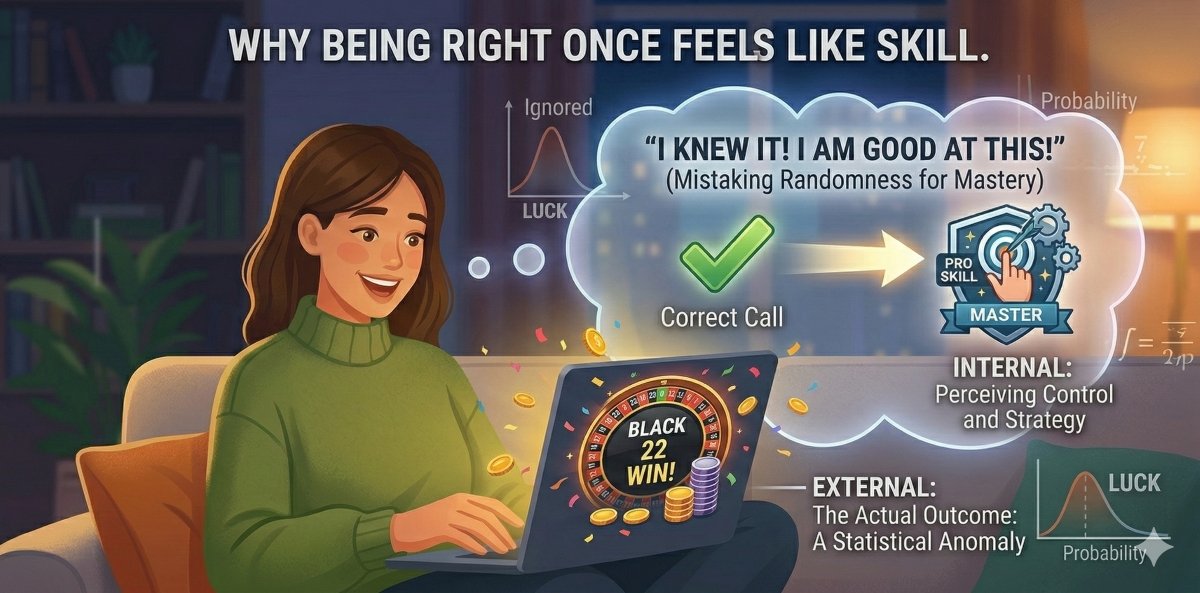
Imagine a person named Alex who decides to try an online casino for the first time. Alex has never played roulette before, but he has seen it in movies. He logs in, looks at the bright digital wheel, and decides to place a small bet on the number 22 because it is his birthday. The wheel spins, the little white ball bounces around, and it lands perfectly on 22.

In that moment, Alex feels a rush of excitement. More importantly, he feels a strange sense of pride. He thinks to himself that he knew it was going to happen. He believes he has a natural feel for the game. This is the exact moment when being right once starts to feel like a skill. For many beginners, this single lucky event can change how they view every game they play afterward.

The Problem with a Good Start

When a person succeeds at something new, their brain wants to find a reason for it. In our daily lives, this is usually a good thing. If you try to bake a cake and it tastes great, it is probably because you followed the instructions well. If you hit a golf ball straight, it is because you had good form. We are used to success being the result of our effort and our choices.

However, online casino games do not work like baking or sports. They are built on a system called a Random Number Generator, or RNG. This is a computer program that makes sure every single result is completely random. When Alex won his roulette bet, it was not because he picked a good number or because he had a special feeling. It was simply a random event that happened to match his choice. Because he was right, his brain ignored the math and focused on his “talent.”

Why Our Brains Trick Us

Human beings are naturally wired to look for patterns. Thousands of years ago, finding patterns helped us find food and stay safe. Today, that same instinct can be a hurdle in an online casino. When we win one time, our brain treats it as a “data point.” If we win a second time, our brain thinks it has found a pattern.

This is often called the illusion of control. We want to believe that we are in charge of our environment. By convincing ourselves that a win was a result of our skill, we feel more powerful. It is much more fun to believe “I am a great player” than to say “I got lucky.” This feeling is very persuasive because it comes with a hit of dopamine, a chemical in the brain that makes us feel rewarded. That chemical reward makes us want to believe the lie that we have mastered the game.

Confusing Choice with Influence

Online casinos are very good at giving players choices. You can choose which slot machine to play, which digital cards to keep, or when to stop a spinning wheel. These choices make the games interactive and fun. However, they also make it easier to mistake luck for skill.

If a player chooses to “stand” in a game of blackjack and the dealer goes over twenty-one, the player feels like they made a smart move. They feel like their decision caused the win. While there is a small amount of strategy in some games, the actual cards dealt are still random. Being right once can make a player feel like they have a special insight into the computer’s logic. They start to believe that they can “read” the game, even though the game is just a series of independent digital outcomes.

The Danger of the Small Sample Size

In the world of math, you need a lot of information to prove a theory. If you want to know if a coin is fair, you cannot just flip it once. If it lands on heads once, that does not mean the coin is broken. You would need to flip it a thousand times to see the truth.

Beginners often make the mistake of using a very small sample size to judge their own skill. They might play for thirty minutes and win three times. To them, those thirty minutes are their whole history. They feel like experts because they are “up” for the day. They do not see the context of the millions of spins that happen every day across the world. They overemphasize their own small experience and ignore the large-scale reality of how casinos work.

Staying Grounded and Safe

The best way to enjoy online games is to constantly remind yourself that a win is a happy accident, not a professional achievement. When you win, enjoy the moment, but do not let it convince you that you have discovered a secret way to beat the system.

By accepting that every result is random, you can keep your expectations realistic. You can set a budget and stick to it because you know that no amount of “skill” can guarantee a result. The most important skill a player can actually have is the ability to walk away when they have reached their limit. This is a real skill because it involves discipline and logic, rather than relying on the feeling of being “right.”

Online casinos should be a form of entertainment. If you view them like a movie or a video game, you can have a great time. Just remember that the house has a mathematical edge, and being right once is just part of the random nature of the game. Keep the fun in the foreground and the “skill” talk in the background.
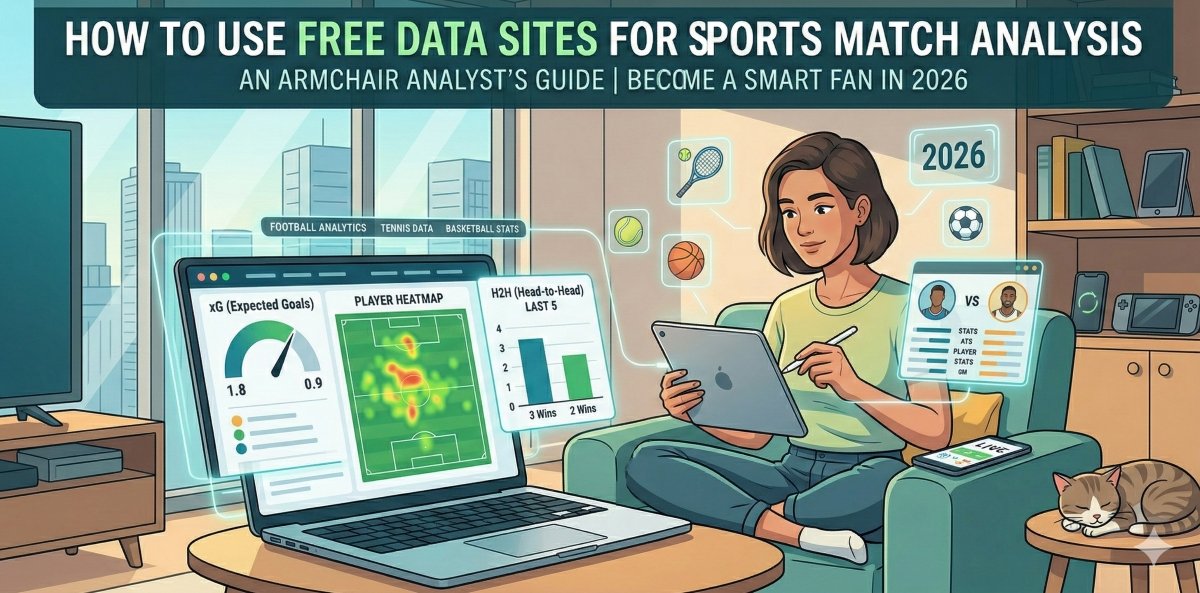
How to Use Free Data Sites for Sports Match Analysis

Watching sports in 2026 is no longer just about sitting on a sofa and cheering for a favorite team. For many fans, the real excitement happens before the whistle blows. This is the era of the “armchair analyst.” Thanks to a handful of powerful and free websites, anyone can look at the same data that professional coaches use. You do not need a degree in math to understand these numbers. You just need to know where to look and how to connect the dots.

Where to Find Your Data

The first step is knowing which tools are worth your time. The internet is full of sports sites, but only a few provide deep, clean data for free.

For football fans, FBref is often the first stop. It is a massive library that covers almost every professional league on the planet. If you want to know how many times a defender in the second division of France has blocked a shot, this site has it. Another great option is WhoScored, which is famous for its player ratings and detailed match previews.

If you prefer basketball, Basketball Reference is the gold standard. For tennis, sites like Ultimate Tennis Statistics offer a deep dive into every serve and volley. These platforms are free because they want to build a community of smart fans, though they often offer “pro” versions for people who want even more detail.

Start with the Story, Not the Numbers

It is easy to get lost in a sea of percentages and decimals. The best way to analyze a match is to start with a simple question. Instead of looking at “data,” try to find a story.

Imagine two teams are playing this weekend. Team A is at the top of the league, and Team B is at the bottom. The simple story is that Team A will win. However, if you look at the “Home vs. Away” stats on a site like Sofascore, you might see that Team A has not won a game away from home in two months. Suddenly, the story changes. Team B might have a real chance because they play very well in their own stadium.

By starting with a question like “How does this team perform under pressure?” you give the numbers a purpose. You are not just reading a list, you are solving a mystery.

Looking Beyond the Final Score

In the past, people only looked at the final score to judge a team. In 2026, we have better tools. One of the most important metrics today is Expected Goals (xG).

Think of xG as a way to measure the quality of a chance. If a striker shoots from one meter away with no goalkeeper, that shot has a very high xG, perhaps 0.95. If they shoot from the halfway line, the xG might be 0.01.

By looking at xG on sites like Understat, you can see if a team was actually playing well or if they just got lucky. If a team wins 1-0 but their xG was only 0.20 while the opponent had 2.50, you know the winner was very fortunate. This information is vital because luck usually runs out. Over time, teams with high xG will eventually start winning more games.

The Power of Player Heatmaps

Data is not just about numbers; it is also about pictures. Many free sites now offer heatmaps. These are colorful maps that show exactly where a player spent their time during a match.

If you are analyzing a game where a star winger was very quiet, look at their heatmap. You might see that they were forced to stay deep in their own half to help with defending. This tells you that the opposing coach had a great plan to stop them. Heatmaps help you see the “invisible” work that happens on the pitch, which is often more important than who scored the goal.

Comparing Head-to-Head Stats

Another simple but effective trick is checking the Head-to-Head (H2H) history. Some teams simply struggle against certain styles of play.

A tall, physical team might always beat a smaller, faster team, no matter where they are in the league standings. Free data sites let you look back at the last five or ten times these two teams met. If Team B has won four of the last five meetings, there is likely a tactical reason for it. Perhaps their defensive style perfectly counters the favorite’s attacking moves.

Avoiding the “Data Trap”

While data is powerful, it is not perfect. A common mistake for beginners is trusting the numbers too much and ignoring reality.

Data cannot tell you if a player is sad because they had a fight with their coach. It cannot tell you if the grass is too long or if the wind is blowing at 50 kilometers per hour. Always use data as a guide, not a guarantee. The best analysts combine what they see with their eyes with what they see on the screen.

Setting Up Your Own System

You do not need fancy software to stay organized. A simple spreadsheet in Google Sheets or Excel is enough.

Start by picking five key stats that you think matter most, such as shots on target, possession, and xG. After every match, spend ten minutes recording these for your favorite team. After a month, you will have your own private database. You will start to notice patterns that the average fan completely misses. This is how you move from being a spectator to being a true expert.

By using these free resources, you are taking control of your sports experience. You are no longer just guessing who might win. You are making decisions based on facts, logic, and the incredible amount of information available at your fingertips in 2026.

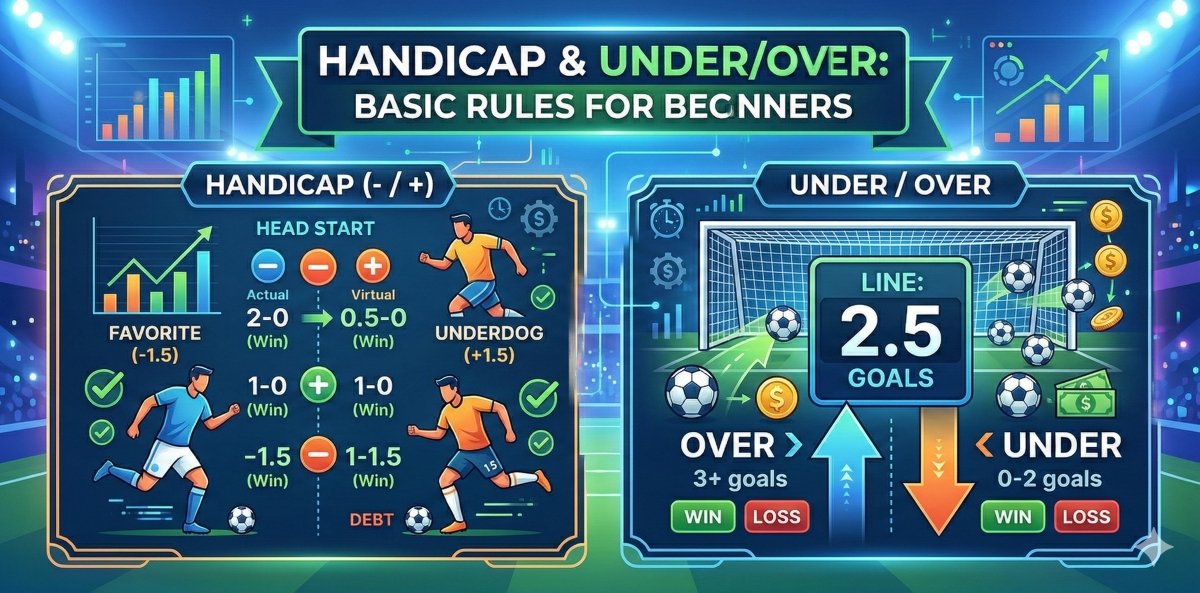
Handicap and Under/Over: Basic Rules for Beginners

If you are new to sports betting, you might feel like you are learning a whole new language. You will see numbers and terms like “Handicap” or “Under/Over” next to the names of teams. These can look confusing at first, but they are actually simple tools designed to make games more interesting to watch and play.

Think of these as different ways to predict what will happen in a match. Instead of just picking who will win, you are predicting how much they will win by or how many total points will be scored.

Understanding the Handicap

A handicap is a way to “even the playing field.” In many sports, one team is much stronger than the other. If everyone knows the strong team will win, the game isn’t very exciting to bet on. To fix this, bookmakers give the weaker team a virtual head start.

The Minus (-) and Plus (+) Symbols

When you look at a handicap, you will see a plus or minus sign followed by a number.

  • The Minus (-): This is for the favorite (the stronger team). They start with a “debt” of points or goals.

  • The Plus (+): This is for the underdog (the weaker team). They start with a “bonus” of points or goals.

Imagine a football match between Team A (the favorite) and Team B (the underdog). The bookmaker might set a handicap of -1.5 for Team A and +1.5 for Team B.

If you bet on Team A at -1.5, they must win by at least two goals for you to win your bet. If they only win 1-0, the “virtual” score would be -0.5 to 0, meaning you lose. If you bet on Team B at +1.5, you win even if they lose the game 1-0, because their virtual score would be 1.5 to 1.

What is Under/Over Betting?

Under/Over betting is even simpler because it doesn’t matter who wins the game. You are only looking at the total number of points, goals, or runs scored by both teams combined.

The bookmaker sets a “line,” which is a specific number. You then decide if the final total will be higher (Over) or lower (Under) than that number.

Why the .5 Matters

You will often see numbers like 2.5 goals or 210.5 points. Bookmakers use the “.5” to make sure there is no tie. Since a team cannot score half a goal, the total must go either above or below that line.

For example, in a basketball game, the line might be 215.5 points.

  • If the final score is 110-105, the total is 215. You win if you bet Under.

  • If the final score is 110-106, the total is 216. You win if you bet Over.

Why Do People Use These Bets?

You might wonder why someone wouldn’t just pick the winner. These types of bets offer a few big advantages for fans:

1. Better Value

If a massive team plays a tiny team, the reward for picking the big team to win is usually very small. By using a handicap, you can get a better reward because you are betting that they will win by a large margin.

2. Staying Interested Until the End

In a normal “who will win” bet, if your team is losing 4-0 at halftime, the bet feels over. But if you bet “Over 5.5 goals,” you are still cheering for every attack until the final whistle, no matter who is winning.

3. Rooting for the Underdog

Handicaps allow you to support a smaller team and still win your bet even if they lose the actual game. It makes watching a match between a giant and a “David” much more thrilling.

Common Mistakes to Avoid

When you are just starting, it is easy to get confused. Here are a few things to keep in mind:

  • Check the Sport: A “point spread” in basketball is the same as a handicap in football, but the numbers are much higher. Always double-check the sport’s scoring style.

  • Overtime Rules: In some sports, like basketball or ice hockey, the Under/Over total includes any points scored in overtime. In others, like football, it might only count the first 90 minutes. Always read the specific rules of the platform you are using.

  • Don’t Chase High Numbers: It can be tempting to bet “Over” on every game because you want to see lots of goals. However, professional teams often play very defensively. Sometimes the “Under” is the smarter choice.

A Quick Summary Table

Bet TypeWhat You Are PredictingKey Symbol
Handicap (-)The favorite wins by more than a certain amount-1.5, -2.0, etc.
Handicap (+)The underdog keeps the game close or wins+1.5, +2.0, etc.
OverBoth teams combined score more than the line> 2.5, > 215.5
UnderBoth teams combined score less than the line< 2.5, < 215.5

Learning these basics is like getting a new pair of glasses to watch sports. You stop seeing just a winner and a loser and start seeing the math and strategy behind every point. It makes the game deeper and, if done responsibly, much more fun to follow.

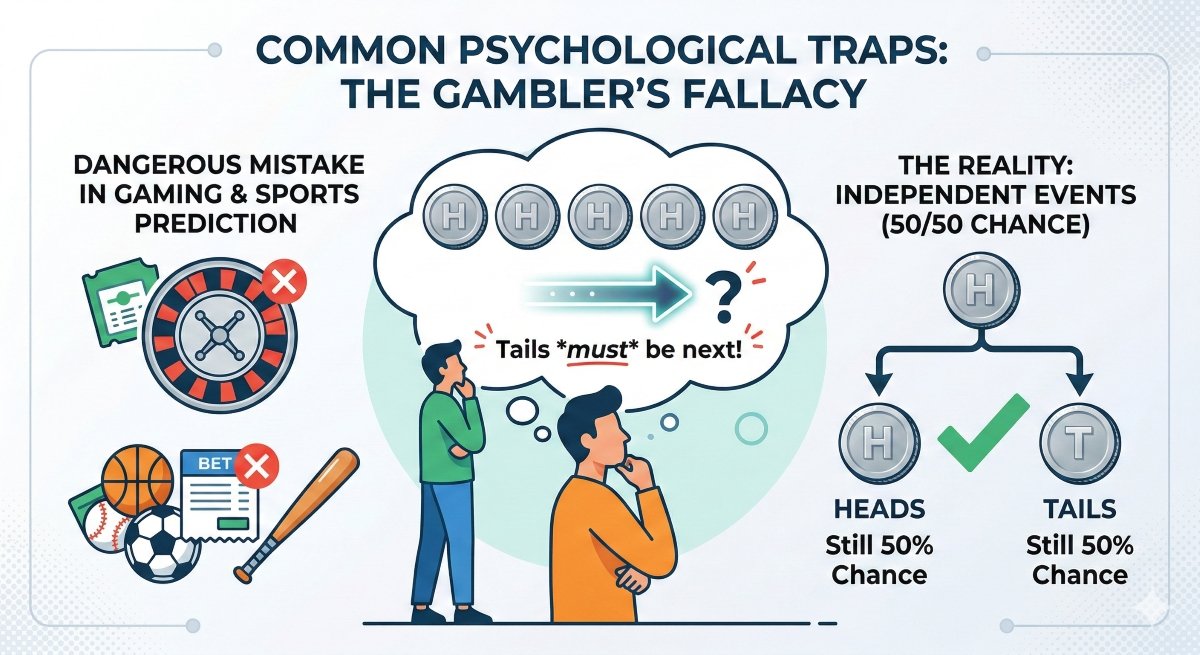
Common Psychological Traps: The Gambler’s Fallacy

When people participate in any form of gaming or sports prediction, they often believe they have a “system” or a special way of seeing patterns. One of the most common and dangerous mistakes a person can make is falling for a psychological trap known as the Gambler’s Fallacy. Understanding this concept is a vital part of building a solid foundation of knowledge in the gaming world.

What is the Gambler’s Fallacy?

The Gambler’s Fallacy is the mistaken belief that if something happens more frequently than normal during a given period, it will happen less frequently in the future. Or, if something has not happened for a long time, it is “due” to happen soon.

Imagine you are flipping a coin. The coin is fair, meaning there is exactly a 50% chance of heads and a 50% chance of tails every single time. If you flip the coin five times and it lands on heads every single time, your brain might start to whisper, “The next one has to be tails. It’s been heads too many times.”

This is the trap. In reality, the coin does not have a memory. It does not know that it just landed on heads five times. The chance of the sixth flip being tails is still exactly 50%. Every flip is an “independent event”.

Why Our Brains Play Tricks on Us

Humans are naturally designed to look for patterns. Thousands of years ago, this helped our ancestors survive. If they saw a pattern in the weather or the movement of animals, it helped them find food and stay safe.

In the modern world, this same instinct can lead us to see patterns where none actually exist. When we see a “streak” of red on a roulette wheel or a team winning three games in a row, our brains want to find a reason for it. We feel uncomfortable with the idea that things are truly random. We want to believe the universe will “balance itself out,” but in games of pure chance, the math does not work that way.

Real-World Examples of the Trap

This fallacy appears in many different areas of life, not just at a casino.

  • The Roulette Table: This is the most famous example. In 1913, at a casino in Monte Carlo, the ball landed on black 26 times in a row. Players lost millions of dollars betting on red because they were convinced that a red win was “due.” They fell for the Gambler’s Fallacy on a massive scale.

  • Sports Predictions: Fans often think that if a star player has missed several shots, they are more likely to make the next one. While a player’s skill matters, each individual shot is influenced by many tiny factors. Thinking a win is “guaranteed” just because of a previous loss is a dangerous way to think.

  • Lottery Numbers: Some people look at which numbers have not been picked in a long time, thinking those numbers are more likely to appear next. In a fair lottery, every ball has the exact same chance of being picked every single time.

How to Avoid the Fallacy

Knowing about the trap is the first step, but you also need practical ways to avoid it.

  1. Remember Independence: Remind yourself that the past does not influence the future in games of chance. Each spin, each flip, and each draw is a brand-new event.

  2. Set Strict Limits: Before you start playing any game, decide exactly how much time or money you will spend. When you reach that limit, stop. This prevents your emotions from taking over when you are on a “losing streak.”

  3. Focus on the Math: Instead of looking for “lucky” patterns, look at the actual probabilities. If a game has a 10% chance of winning, that 10% stays the same every single time you play, regardless of what happened five minutes ago.

  4. Take Breaks: When you feel a strong “feeling” that a certain result is coming, take a walk. Stepping away helps clear the “fog” of the fallacy and allows your logical brain to take control again.

Building a Stronger Ecosystem of Knowledge

By learning about concepts like the Gambler’s Fallacy, you are participating in a better way of interacting with the world. You are moving away from simple, fragile ideas and toward a more robust understanding.

This information layer helps you stay safe, think clearly, and avoid the common mistakes that many others make. Whether you are a casual gamer or just someone interested in human psychology, keeping these lessons in mind will help you navigate the digital landscape with confidence.

The “Sunk Cost” Trap: Why It Is Hard to Stop After a Loss and How to Stay in Control

Imagine you are waiting for a bus. You have already waited for 30 minutes, but it has not arrived. You are worried you will be late. You could call a taxi right now and still arrive on time. However, you think to yourself, “I have already waited 30 minutes. If I leave now, that time was wasted. I should wait just a little longer.”

Another 20 minutes pass. The bus still hasn’t come. Now you are definitely late, and you are too frustrated to call a taxi.

This situation is a perfect example of a psychological trap that affects almost everyone. In finance and decision-making, this is called the Sunk Cost fallacy or trap. It is one of the main reasons beginners lose control of their money and make losses much bigger than they need to be.

This article explains what the trap is in simple terms, why our brains fall for it, and how you can learn to escape it.

What Is a “Sunk Cost”?

A sunk cost is any money, time, or effort you have already spent that you cannot get back. It is gone forever.

  • The price of a movie ticket you already bought is a sunk cost.
  • The three years you spent studying a subject you no longer like is a sunk cost.
  • The money you lost on an investment yesterday is a sunk cost.

The core rule of smart decision-making is this: Sunk costs should not affect your future decisions. Because that money or time is already gone, it does not matter anymore. You should only focus on what is best for your future right now.

The Trap: Throwing Good Money After Bad

The trap happens when we ignore that rule. Instead of looking forward, we look backward at what we already spent. We feel an emotional need to “justify” the past expense or try to “win back” the loss.

In financial terms, this often leads to the dangerous habit of “throwing good money after bad.”

For example, imagine you bought shares in a company for $1,000. A week later, the company has bad news, and your shares are now worth $700. You have a paper loss of $300.

A logical approach would be to ask: “Is this company likely to recover soon?” If the answer is no, the best move is to sell, accept the $300 loss, and save the remaining $700.

However, the Sunk Cost Trap makes you think differently. You might say, “I cannot sell now; I will lock in the loss! I need to wait until it gets back to $1,000 so I can break even.” Some people even buy more shares, trying to lower their average price.

Often, the price keeps dropping, and the $300 loss turns into a $600 loss. Trying to save the initial sunk cost ends up costing even more money.

Why Is It So Hard to Stop?

Why do intelligent humans do this? It is not because we are stupid; it is because we are emotional.

1. Loss Aversion

Psychologists have found that humans feel the pain of a loss twice as strongly as the joy of a gain. Losing $100 feels much worse than finding $100 feels good. We will do almost anything to avoid admitting we have officially lost money.

2. Fear of Waste

We are taught from a young age not to be wasteful. Admitting a mistake feels like admitting you wasted time or money. We stick with bad projects because we want to believe our initial effort had value.

3. Hope Over Logic

When we are in a losing position, we stop thinking with facts and start thinking with hope. We hope the situation will turn around magically, even if all the evidence says it will get worse.

How to Stay in Control and Escape the Trap

Recognizing that this trap exists is the first step to beating it. Here are practical ways to stay in control when you are facing a loss.

The “Clean Slate” Test

If you are holding a losing investment and don’t know if you should sell, use this mental trick. Imagine you do not own the investment at all. You have cash in your hand instead.

Now, look at that investment today. Would you buy it right now at its current price?

If the answer is “No, I wouldn’t buy that today,” then you should sell it immediately. If it’s not good enough to buy today, it is not good enough to keep.

Focus on the Future Opportunity

Do not think about the money you lost. Think about what the remaining money could do.

If you have $700 left from a bad investment, don’t focus on the missing $300. Focus on the fact that the $700 is currently trapped. If you sell, you free up that $700 to be placed into a much better opportunity that might actually grow.

Set Rules Before You Start

The best way to avoid emotional decisions is to make rules when you are calm. Before you put money into anything, decide your “exit point.”

For example: “If this drops by 10%, I will sell immediately, no questions asked.” This is often called a stop-loss. When you hit that point, do not argue with yourself. Just follow the rule you made earlier.

Core Takeaway

It is painful to accept that money is gone. No one likes to lose. However, successful people understand that trying to fix a past mistake by spending more money is a recipe for disaster.

The Sunk Cost Trap is just a trick of the mind. By letting go of the past and focusing only on the best action for today, you can regain control of your decisions and protect your future finances. Sometimes, the smartest thing you can do is quit.

Why Lessons Only Appear When They Are Over

Have you ever gone through a very hard time in your life? Maybe you lost a job, a relationship ended, or you failed at a big project. At that moment, you probably felt confused, angry, or sad. You might have asked yourself, “Why is this happening to me?” Everything felt like a messy puzzle with missing pieces.

But then, a year or two later, you look back at that same difficult time. Suddenly, everything looks different. You think, “Ah, I see now. I had to lose that job to find this better one,” or “That failure taught me what I really needed to know.”

This feeling is very common. It seems that life’s biggest lessons only become clear after the difficult part is over. As Steve Jobs once said, “You can’t connect the dots looking forward; you can only connect them looking backward.”

Why does our brain work this way? Why can’t we see the lesson while we are learning it? Let’s explore the psychology behind why clarity only comes in retrospect.

Living Inside the Maze

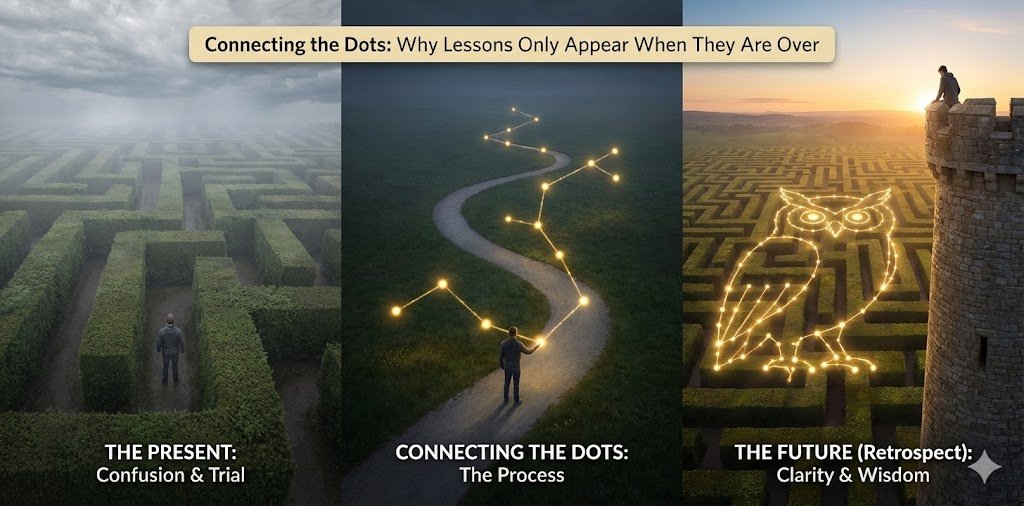
Imagine life is a giant hedge maze. When you are standing inside the maze, all you can see are tall green walls. You don’t know if you should turn left or right. You might choose a path that leads to a dead end, and you have to turn around. You feel frustrated and lost.

This is what it feels like to live in the present moment. When you are in the middle of a problem, you are inside the maze. You do not have all the information. You are making guesses based on what is right in front of you.

Your brain is also busy dealing with strong emotions. Fear, worry, and stress act like a fog. They make it hard to think clearly. When your brain is in “survival mode,” it is focused on getting through the day, not on learning a big life lesson. You are too close to the problem to see the solution.

The Science of Hindsight

Now, imagine that enough time has passed, and you have finally found your way out of the maze. You climb up a tall tower and look down. From up high, the maze looks simple. You can clearly see the start, the finish, and the exact path you took. You can also see all the wrong turns you made and why they were wrong.

This view from the tower is called “retrospect.” In psychology, this is linked to hindsight bias—the feeling that “I knew it all along.”

Once your brain knows the ending of a story, it rewrites the past. It deletes the confusion you felt at the time and highlights only the clues that point to the final outcome. The past looks like a straight, obvious line, even though it felt like a messy scribble when you were living it.

Think of a child’s connect-the-dots drawing. When there are just numbered dots on a page, you don’t know what the picture is. Only when you connect the final dot does the full image appear. Life is the same. You have to live through the events—connect the dots—before you can see the lesson.

A Story About a Bridge

Consider a simple story. A man named Leo wanted to build a small wooden bridge over a stream in his backyard. He had never built a bridge before.

While he was building it, Leo was stressed. He worried that the wood wasn’t strong enough. He wasn’t sure if the supporting stones were in the right spots. He made mistakes; sometimes the wood cracked, or a stone slipped. He felt like a bad builder and wanted to quit many times. He was “inside the maze.”

A year later, the bridge was finished and standing strong. Leo stood on top of it and looked down. In retrospect, everything was clear. He could see that the wood cracked because he didn’t drill a pilot hole first. He saw that the stone slipped because the ground was too wet that day.

The lessons were obvious now because the work was done. In the moment, he was fighting the problems. In retrospect, he was studying the results. The confusion he felt back then was just the necessary process of learning how to build.

How to Trust the Process

So, what can we do with this information? It is important to be kind to yourself when things are tough.

Don’t beat yourself up for not knowing the future. It is impossible to know the lesson before you have finished the experience. Trust that the confusion you feel right now is normal. It does not mean you are failing; it just means you are still connecting the dots.

Be patient in the messy middle. Keep moving forward, even if you don’t know exactly where you are going. One day, you will look back from your own tower, and it will all make perfect sense. The clarity is coming; it is just waiting for you at the end of the path.

Core Takeaway

Lessons rarely appear in the moment—they reveal themselves in hindsight. The struggle, confusion, and uncertainty are part of the process. Only when the experience is complete does the brain reorganize events into meaning. Trust the process, keep connecting the dots, and remember: clarity is waiting for you at the end.

Why Experience Does Not Eliminate Risk Bias

Experience is often treated as a cure for poor judgment. The assumption is that with time and repeated exposure, people learn restraint, accuracy, and realism. In systems involving repeated risk, however, this assumption frequently fails. Confidence grows while accuracy does not. Familiarity increases, yet bias persists.

This is not because experience lacks value. It is because experience interacts with human psychology in a way that tends to reinforce intuition rather than refine understanding. Risk bias survives repetition because repetition does not change how probability behaves—it changes how decisions feel. As a result, bias can remain intact even as experience accumulates.

Why Familiarity Feels Like Skill

Repeated exposure reduces anxiety. What once felt uncertain becomes routine. This reduction in emotional friction is often mistaken for improved judgment.

Familiarity creates comfort, and comfort feels like competence. People assume they understand a system better simply because it no longer feels confusing. In reality, the structure has not become clearer—it has only become familiar.

This miscalibration allows bias to persist beneath a surface that looks like expertise.

Why Experience Reinforces Existing Narratives

People do not enter systems without prior beliefs. Early interpretations shape how later outcomes are processed.

Experience supplies more material to support existing narratives. Wins are remembered. Losses are explained away. Near failures are reframed as progress. Over time, selective memory hardens belief.

Rather than correcting bias, experience often deepens it.

Why Feedback Remains Ambiguous

Experience improves judgment only when feedback is clear and diagnostic. Risk-based systems rarely provide such clarity.

Outcomes do not reliably reflect decision quality. Losses occur even after sound choices, and wins occur after poor ones. Without consistent signals, experience loses its corrective power.

Ambiguous feedback allows bias to persist without being challenged.

Why Emotional Learning Outpaces Statistical Learning

Humans learn emotionally faster than they learn statistically. Every outcome is felt before it is analyzed.

Experience strengthens emotional associations. Certain patterns begin to feel right or wrong regardless of their actual relevance. These feelings guide behavior more powerfully than abstract probability.

As emotional learning accelerates, statistical understanding falls behind—a dynamic closely related to how confidence grows faster than understanding in repeated decision environments, as explored in why confidence outpaces comprehension.

Why Confidence Grows Faster Than Accuracy

Confidence is reinforced by action and familiarity. Accuracy requires aggregation, reflection, and restraint.

Experience provides action but does not automatically provide reflection. As a result, confidence inflates while accuracy stagnates.

This gap explains why more experienced individuals can sometimes be more biased than novices.

Why Experience Does Not Correct the Illusion of Control

Repeated decisions increase the sense of agency. Frequent involvement feels like influence.

Even when outcomes are largely independent, experience creates the illusion that personal adjustment matters. People believe they are adapting effectively even when the risk structure remains unchanged—an effect widely studied as the illusion of control.

Because this illusion strengthens with repetition, it rarely disappears through experience alone.

How Social Reinforcement Locks Bias in Place

Experienced participants often assume social roles as veterans or advisors. Their interpretations gain authority.

Social reinforcement stabilizes bias. When experience is equated with correctness, challenging existing beliefs becomes more difficult.

Bias persists not because it is unexamined, but because it is socially validated.

Why This Pattern Appears Everywhere

These dynamics appear in finance, forecasting, performance evaluation, and any environment involving repeated uncertainty. Experience reduces surprise, not error.

Risk bias is not eliminated by exposure alone. It requires structured reflection, delayed feedback, and explicit recalibration. Without these mechanisms, experience becomes a confidence amplifier, not a corrective tool.

Core Takeaway

Experience does not eliminate risk bias because bias does not arise from inexperience. It arises from how humans interpret feedback under uncertainty. Repetition strengthens intuition faster than accuracy, allowing bias to hide behind the appearance of expertise. True correction requires deliberate reflection, not exposure alone.

Why Humans Expect Balance in Random Sequences

When people encounter random outcomes, they instinctively expect balance. Wins should offset losses. High results should be followed by low ones. Over time, things are expected to flatten out in a visible, orderly way. When this does not happen, randomness begins to feel suspicious.

This expectation runs deep. It feels intuitive, reasonable, and fair. Yet it does not reflect how random processes actually behave. Randomness does not aim for balance in short sequences. It naturally produces clustering, streaks of wins or losses, and uneven distributions as a consequence of chance itself. This persistent psychological tension is the reason humans frequently misinterpret random sequences, as the brain struggles to accept that true randomness looks far messier than our mental models of it.

Why Balance Feels Like Fairness

Humans tend to associate balance with justice. In everyday life, effort is often rewarded and mistakes are often corrected. Over time, things usually even out in ways that feel reasonable.

These experiences shape how randomness is interpreted. A balanced sequence aligns with moral intuition and therefore feels fair. An imbalanced sequence violates expectations about how things should unfold and therefore feels unfair. Random systems are indifferent to fairness. They do not self-correct to satisfy human intuition.

Why the Mind Searches for Symmetry

The human brain is a pattern-detection machine. It evolved to look for order, symmetry, and repetition—traits that were useful in predictable environments. In random sequences, this instinct misfires. The mind expects alternation and correction even when no causal relationship exists. When results repeat or cluster, the brain assumes something has changed.

Symmetry feels normal. Asymmetry feels suspicious.

Why Short Sequences Dominate Perception

People rarely evaluate randomness using large samples. Instead, randomness is experienced in short runs. In short sequences, imbalance is common. Long streaks, clusters, and gaps occur naturally. Without sufficient context, these sequences feel meaningful rather than expected.

Because early experiences dominate memory, people conclude that randomness itself is malfunctioning—a pattern that closely mirrors why early wins are especially misleading.

How Recency Bias Strengthens the Expectation

Recent outcomes feel more informative than earlier ones. When a sequence leans heavily in one direction, recency bias amplifies discomfort. Instead of recognizing that randomness allows uneven runs, people believe balance is overdue. The longer the imbalance persists, the stronger the expectation becomes. This creates the false belief that the next outcome must restore balance.

Why Clustering Feels Like Manipulation

Clustering violates intuition. When the same result appears repeatedly, it feels intentional. People assume systems should prevent extreme streaks. When they do not, suspicion grows. Randomness is reinterpreted as bias, manipulation, or design failure.

In reality, clustering is not a failure of randomness—it is one of its defining features. This misunderstanding is commonly known as the gambler’s fallacy.

Why the Law of Large Numbers Is Misapplied

Many people vaguely understand that outcomes tend to converge toward averages over time. This idea, however, is often misused. Balance emerges statistically across very large samples—not emotionally salient short sequences. Expecting rapid balance applies a long-term principle to short-term experience. This misapplication fuels disappointment and mistrust.

Why Experience Rarely Corrects the Expectation

Even repeated exposure rarely eliminates the expectation of balance. Emotional responses to imbalance are strong and persistent. People remember extreme streaks more vividly than ordinary runs. These memories reinforce the belief that imbalance is abnormal. Intellectual understanding of randomness does not automatically regulate how imbalance feels.

Why This Expectation Appears Everywhere

The expectation of balance appears in games, finance, forecasting, and everyday judgment. Wherever randomness is encountered repeatedly, the same discomfort emerges. Humans did not evolve to intuitively understand probability distributions. They evolved to respond to patterns. Randomness exploits that mismatch.

Humans expect balance in random sequences because balance feels fair, orderly, and reassuring. Randomness does not share those priorities. It naturally produces imbalance—often early, frequently, and without explanation. Until this difference is recognized, random sequences will continue to feel wrong even when they are functioning exactly as intended.

Core Takeaway

Randomness is not broken when it produces streaks, clusters, or imbalance. It is behaving exactly as probability dictates. The human expectation of balance reflects moral intuition and pattern-seeking instincts, not statistical reality. Recognizing this mismatch helps explain why random systems often feel unfair, even when they are perfectly neutral.

Why Confidence Grows Faster Than Understanding

Confidence often arrives early. Understanding takes time. In systems built around repeated decisions, constant feedback, and persistent uncertainty, this gap becomes especially visible. People grow increasingly certain about what they are doing long before they can explain why outcomes occur—or what those outcomes actually represent.

This separation is not accidental. It is a natural result of how confidence and understanding form. They rely on different signals, develop on different timelines, and respond to different kinds of feedback. This psychological drift is heavily influenced by frequency bias and the illusion of proficiency, where repeated exposure is misinterpreted as increasing mastery.

Why Confidence Responds to Exposure

Confidence grows through exposure. The more frequently someone interacts with a system, the less unfamiliar it feels. Familiarity reduces anxiety, and reduced anxiety is often interpreted as competence. Each interaction reinforces the sense that the environment is manageable. Even when outcomes remain unpredictable, navigating the system feels smoother. That smoothness is easily mistaken for skill.

Confidence does not require accuracy. It only requires comfort.

Why Understanding Requires Structure

Understanding does not develop through repetition alone. It requires structure. Understanding emerges from connecting outcomes to underlying rules, constraints, and probabilities.

This process is slow because it depends on abstraction. Patterns cannot be inferred from single events; they must be evaluated across many outcomes. Models must be tested and refined while tolerating ambiguity. Understanding resists fast feedback. It grows in quiet, not intensity.

Why Feedback Strengthens Confidence More Than Insight

In repeated decision environments, feedback is frequent and emotionally charged. Each outcome feels like a response to action. This kind of feedback reinforces confidence because it rewards participation itself. Something happened, therefore something was done. Understanding, however, is not directly reinforced. Systems reward engagement, not correct interpretation.

As a result, insight lags while confidence accelerates—a dynamic that becomes clearer when examining why experience does not eliminate risk bias.

Why Emotional Learning Outpaces Cognitive Learning

Humans learn emotionally faster than they learn analytically. Emotion attaches to outcomes immediately, before meaning is processed. Confidence benefits from this speed. A small number of positive experiences can generate strong belief. Understanding requires slower cognitive work that integrates context, probability, and limitation.

The emotional system reaches conclusions before the analytical system finishes processing. Psychology often describes this pattern as the illusion of validity.

Why Early Certainty Feels Productive

Certainty feels efficient. Doubt feels like delay. When confidence grows quickly, momentum follows. Decisions become easier, hesitation fades, and this efficiency feels like improvement—even when understanding has not deepened. People often mistake decisiveness for insight.

Why Understanding Is Quiet

Understanding rarely announces itself. It does not arrive with emotional highs or clear completion signals. Because it is quiet, it is easy to overlook. Confidence is noticeable because it changes how one feels. Understanding changes how one thinks, which is less immediately visible. Systems that reward action amplify this imbalance.

Why Experience Alone Does Not Close the Gap

Experience provides exposure, not explanation. Without deliberate reflection, the same patterns repeat and reinforce themselves. Confidence grows with every repetition. Understanding requires interruption—pausing, aggregating outcomes, and reevaluating assumptions. When those conditions are absent, the gap widens.

Why the Pattern Persists

Once confidence pulls ahead of understanding, it tends to stay there. Confidence reduces curiosity, and reduced curiosity slows learning. This creates a self-reinforcing loop. People stop asking questions because they feel capable. Confidence continues to rise while understanding plateaus.

Why Recognizing the Gap Matters

The gap between confidence and understanding explains many misjudgments in repeated decision environments. People are not overconfident because they are careless. They are overconfident because systems reward familiarity faster than comprehension.

Confidence grows quickly because it feeds on exposure, emotion, and repetition. Understanding depends on structure, patience, and restraint. Without intentional slowing and reflection, experience alone will continue to widen the distance between them.

Core Takeaway

Confidence and understanding are not synchronized. Confidence thrives on exposure and emotion; understanding requires structure and reflection. Recognizing this gap helps explain why people often feel certain long before they truly comprehend a system. Closing the gap means slowing down, questioning assumptions, and valuing process over immediate reassurance.

When Efficient Systems Feel Unfair

Efficient systems are designed to operate quickly and consistently. Information moves fast, responses converge, and outcomes reflect signals with minimal delay. From a technical standpoint, this is often how fairness is implemented at scale: the same rules are applied uniformly, with speed and reach. Yet the lived experience of people inside these systems frequently tells a different story. Outcomes appear uneven, advantages seem to cluster, and losses recur in ways that feel difficult to explain.

This is where tension emerges. Efficiency optimizes how a system processes information. Fairness, by contrast, is judged through the experience of those affected by the results. When these two standards begin to diverge, even a well-designed system can feel unfair. This is a primary reason why fair systems can feel as though they are manipulated or rigged, as individuals struggle to reconcile technical neutrality with their personal results.

Understanding this gap requires separating how systems are designed from how humans experience them. Market efficiency and fairness are not opposites. They optimize for different objectives. When they align, trust forms. When they separate, systems can feel manipulated even in the absence of manipulation.

What Market Efficiency Actually Means

Market efficiency is a descriptive concept, not a moral one. At its simplest, an efficient market is one where available information is rapidly reflected in outcomes. Prices adjust, signals are absorbed, and advantages based on public information disappear quickly as many participants respond at once. In economics, this idea is often described through versions of the efficient market hypothesis.

Efficiency does not guarantee equal outcomes. It does not reward effort evenly, nor does it account for intention. Its function is alignment, not justice. As markets become more efficient, predictable advantages shrink, and competition over timing, access, and interpretation intensifies. This compression makes outcomes feel harsher, because there is less room for error.

What People Mean by Fairness

Fairness is not a single metric. It is a judgment shaped by process, context, and expectation. People assess fairness based on whether rules were applied consistently, whether effort seemed respected, and whether outcomes felt proportional to inputs. Visibility also matters. The more people understand why something happened, the easier it is to accept an unfavorable result.

Unlike efficiency, fairness is evaluated locally. People do not experience markets as abstract systems. They experience them through sequences of outcomes, near misses, delays, and feedback. A system can be statistically fair in aggregate while feeling unfair to participants whose repeated experiences conflict with what the rules seem to promise.

Why Efficient Systems Often Feel Unfair

Efficient systems amplify small differences quickly. Timing, access to information, and initial position compound into meaningful gaps over short periods. When outcomes begin clustering in one direction, observers infer structure. Repeated success looks like privilege. Repeated failure feels like exclusion.

Opacity compounds this effect. To maintain speed and scale, efficient systems often obscure their internal mechanics. Algorithms, pricing models, queues, and ranking systems prioritize performance over interpretability. When results are visible but explanations are not, people fill the gap with narratives—especially when humans instinctively expect balance in random sequences, even when no such balance exists, a tendency explored in why people expect fairness in randomness.

The mismatch between effort and reward also plays a role. Humans expect effort to correlate roughly with outcome. Efficient markets routinely violate this intuition. Effort may be necessary, but it is rarely sufficient. Without favorable conditions, significant input can produce no result.

Aggregate Fairness Versus Individual Experience

A system can be statistically fair across all participants while generating sustained disadvantage in specific segments. This creates a gap between aggregate outcomes and personal narratives. People do not judge fairness by averages. They judge it by their own sample.

This local perspective matters because trust forms through repeated experience, not abstract explanation. For someone who consistently encounters losses under consistent rules, assurances of overall fairness do not resolve the emotional contradiction. Their data tells a different story.

Why This Tension Matters

Understanding the difference between efficiency and fairness is not about choosing one over the other. It is about recognizing that systems optimized for performance are not optimized for human perception. When this gap is ignored, confusion and resentment fill the space.

Market efficiency answers the question: Does this system process information well?

Fairness answers the question: Does this experience feel just to me?

When those answers diverge, the resulting conflict is not a failure. It is a predictable outcome of humans interpreting systems that move faster than intuition.

Core Takeaway

Efficient systems can be fair in design yet feel unfair in practice. Efficiency ensures information is processed quickly and consistently, but fairness is judged through lived experience. Recognizing this distinction helps explain why systems that are technically neutral often feel biased, and why trust depends not only on efficiency but on how fairness is communicated and perceived.