

If you are new to sports betting, you might feel like you are learning a whole new language. You will see numbers and terms like “Handicap” or “Under/Over” next to the names of teams. These can look confusing at first, but they are actually simple tools designed to make games more interesting to watch and play.
Think of these as different ways to predict what will happen in a match. Instead of just picking who will win, you are predicting how much they will win by or how many total points will be scored.
Understanding the Handicap
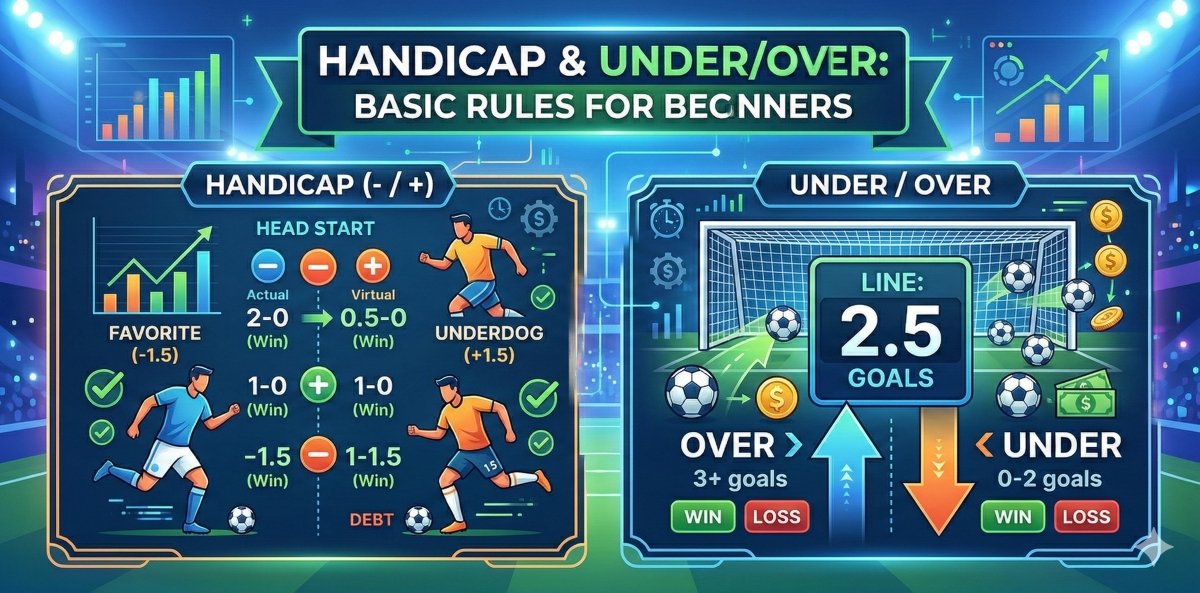
A handicap is a way to “even the playing field.” In many sports, one team is much stronger than the other. If everyone knows the strong team will win, the game isn’t very exciting to bet on. To fix this, bookmakers give the weaker team a virtual head start.
The Minus (-) and Plus (+) Symbols
When you look at a handicap, you will see a plus or minus sign followed by a number.
The Minus (-): This is for the favorite (the stronger team). They start with a “debt” of points or goals.
The Plus (+): This is for the underdog (the weaker team). They start with a “bonus” of points or goals.
Imagine a football match between Team A (the favorite) and Team B (the underdog). The bookmaker might set a handicap of -1.5 for Team A and +1.5 for Team B.
If you bet on Team A at -1.5, they must win by at least two goals for you to win your bet. If they only win 1-0, the “virtual” score would be -0.5 to 0, meaning you lose. If you bet on Team B at +1.5, you win even if they lose the game 1-0, because their virtual score would be 1.5 to 1.
What is Under/Over Betting?
Under/Over betting is even simpler because it doesn’t matter who wins the game. You are only looking at the total number of points, goals, or runs scored by both teams combined.
The bookmaker sets a “line,” which is a specific number. You then decide if the final total will be higher (Over) or lower (Under) than that number.
Why the .5 Matters
You will often see numbers like 2.5 goals or 210.5 points. Bookmakers use the “.5” to make sure there is no tie. Since a team cannot score half a goal, the total must go either above or below that line.
For example, in a basketball game, the line might be 215.5 points.
If the final score is 110-105, the total is 215. You win if you bet Under.
If the final score is 110-106, the total is 216. You win if you bet Over.
Why Do People Use These Bets?
You might wonder why someone wouldn’t just pick the winner. These types of bets offer a few big advantages for fans:
1. Better Value
If a massive team plays a tiny team, the reward for picking the big team to win is usually very small. By using a handicap, you can get a better reward because you are betting that they will win by a large margin.
2. Staying Interested Until the End
In a normal “who will win” bet, if your team is losing 4-0 at halftime, the bet feels over. But if you bet “Over 5.5 goals,” you are still cheering for every attack until the final whistle, no matter who is winning.
3. Rooting for the Underdog
Handicaps allow you to support a smaller team and still win your bet even if they lose the actual game. It makes watching a match between a giant and a “David” much more thrilling.
Common Mistakes to Avoid
When you are just starting, it is easy to get confused. Here are a few things to keep in mind:
Check the Sport: A “point spread” in basketball is the same as a handicap in football, but the numbers are much higher. Always double-check the sport’s scoring style.
Overtime Rules: In some sports, like basketball or ice hockey, the Under/Over total includes any points scored in overtime. In others, like football, it might only count the first 90 minutes. Always read the specific rules of the platform you are using.
Don’t Chase High Numbers: It can be tempting to bet “Over” on every game because you want to see lots of goals. However, professional teams often play very defensively. Sometimes the “Under” is the smarter choice.
A Quick Summary Table
| Bet Type | What You Are Predicting | Key Symbol |
| Handicap (-) | The favorite wins by more than a certain amount | -1.5, -2.0, etc. |
| Handicap (+) | The underdog keeps the game close or wins | +1.5, +2.0, etc. |
| Over | Both teams combined score more than the line | > 2.5, > 215.5 |
| Under | Both teams combined score less than the line | < 2.5, < 215.5 |
Learning these basics is like getting a new pair of glasses to watch sports. You stop seeing just a winner and a loser and start seeing the math and strategy behind every point. It makes the game deeper and, if done responsibly, much more fun to follow.