

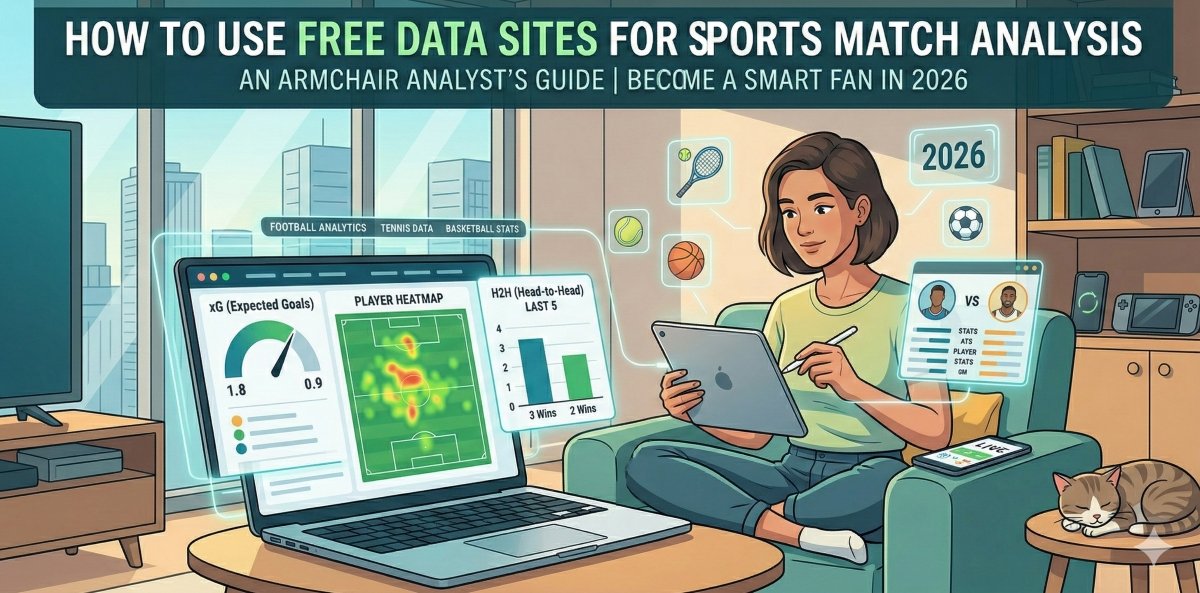
Watching sports in 2026 is no longer just about sitting on a sofa and cheering for a favorite team. For many fans, the real excitement happens before the whistle blows. This is the era of the “armchair analyst.” Thanks to a handful of powerful and free websites, anyone can look at the same data that professional coaches use. You do not need a degree in math to understand these numbers. You just need to know where to look and how to connect the dots.
Where to Find Your Data
The first step is knowing which tools are worth your time. The internet is full of sports sites, but only a few provide deep, clean data for free.
For football fans, FBref is often the first stop. It is a massive library that covers almost every professional league on the planet. If you want to know how many times a defender in the second division of France has blocked a shot, this site has it. Another great option is WhoScored, which is famous for its player ratings and detailed match previews.
If you prefer basketball, Basketball Reference is the gold standard. For tennis, sites like Ultimate Tennis Statistics offer a deep dive into every serve and volley. These platforms are free because they want to build a community of smart fans, though they often offer “pro” versions for people who want even more detail.
Start with the Story, Not the Numbers
It is easy to get lost in a sea of percentages and decimals. The best way to analyze a match is to start with a simple question. Instead of looking at “data,” try to find a story.
Imagine two teams are playing this weekend. Team A is at the top of the league, and Team B is at the bottom. The simple story is that Team A will win. However, if you look at the “Home vs. Away” stats on a site like Sofascore, you might see that Team A has not won a game away from home in two months. Suddenly, the story changes. Team B might have a real chance because they play very well in their own stadium.
By starting with a question like “How does this team perform under pressure?” you give the numbers a purpose. You are not just reading a list, you are solving a mystery.
Looking Beyond the Final Score
In the past, people only looked at the final score to judge a team. In 2026, we have better tools. One of the most important metrics today is Expected Goals (xG).
Think of xG as a way to measure the quality of a chance. If a striker shoots from one meter away with no goalkeeper, that shot has a very high xG, perhaps 0.95. If they shoot from the halfway line, the xG might be 0.01.
By looking at xG on sites like Understat, you can see if a team was actually playing well or if they just got lucky. If a team wins 1-0 but their xG was only 0.20 while the opponent had 2.50, you know the winner was very fortunate. This information is vital because luck usually runs out. Over time, teams with high xG will eventually start winning more games.
The Power of Player Heatmaps
Data is not just about numbers; it is also about pictures. Many free sites now offer heatmaps. These are colorful maps that show exactly where a player spent their time during a match.
If you are analyzing a game where a star winger was very quiet, look at their heatmap. You might see that they were forced to stay deep in their own half to help with defending. This tells you that the opposing coach had a great plan to stop them. Heatmaps help you see the “invisible” work that happens on the pitch, which is often more important than who scored the goal.
Comparing Head-to-Head Stats
Another simple but effective trick is checking the Head-to-Head (H2H) history. Some teams simply struggle against certain styles of play.
A tall, physical team might always beat a smaller, faster team, no matter where they are in the league standings. Free data sites let you look back at the last five or ten times these two teams met. If Team B has won four of the last five meetings, there is likely a tactical reason for it. Perhaps their defensive style perfectly counters the favorite’s attacking moves.
Avoiding the “Data Trap”
While data is powerful, it is not perfect. A common mistake for beginners is trusting the numbers too much and ignoring reality.
Data cannot tell you if a player is sad because they had a fight with their coach. It cannot tell you if the grass is too long or if the wind is blowing at 50 kilometers per hour. Always use data as a guide, not a guarantee. The best analysts combine what they see with their eyes with what they see on the screen.
Setting Up Your Own System
You do not need fancy software to stay organized. A simple spreadsheet in Google Sheets or Excel is enough.
Start by picking five key stats that you think matter most, such as shots on target, possession, and xG. After every match, spend ten minutes recording these for your favorite team. After a month, you will have your own private database. You will start to notice patterns that the average fan completely misses. This is how you move from being a spectator to being a true expert.
By using these free resources, you are taking control of your sports experience. You are no longer just guessing who might win. You are making decisions based on facts, logic, and the incredible amount of information available at your fingertips in 2026.